
Under
Pressure
How nationalist and authoritarian
politics shape exhibition design
Context
Master’s thesis and exhibition concept, MA Exhibition Design, FH JOANNEUM Graz, 2026
Exhibition concept
“The Power of Staging”, designed for the Graz Museum
Supervisor
FH-Prof. Dipl.-Rest. Erika Thümmel
Target audience
Young people aged 14 to 30
Problem
Statement
Museums are places of education, knowledge, participation, historical reckoning, and public memory. The public generally views them as more trustworthy than scientists. At the same time, museums are not neutral. As institutions that tell stories, select objects, and create meanings, museums wield significant cultural and political influence. As such, they can also become the focus of political influence, as is currently happening in the US under Donald Trump or as occurred in Hungary under Viktor Orbán. This influence is not always obvious. Structural mechanisms such as executive measures, funding decisions, institutional restructuring, the replacement of leadership personnel, or the non-renewal of contracts are used to reshape museum narratives, reinforce national identity narratives, or marginalise controversial issues such as colonialism, migration, or minority rights.
These developments cannot be viewed separately. They are linked to a global rise in authoritarian and anti-democratic tendencies, in the wake of which cultural institutions are increasingly becoming part of an ideological culture war. This debate is not limited solely to institutional structures, collections, or exhibition themes. It also concerns the way in which history, identity, and societal realities are staged and conveyed. Exhibition design therefore emerges as a previously underexamined dimension of political influence and a key concern of this study.
Are museums today directly influenced by nationalist and authoritarian forces? How does this influence affect them, and what role does exhibition design play?
Theory
The theoretical part of the thesis is built on four central premises:
1. Museums are not neutral
According to curator and theorist Nora Sternfeld, it was long taken for granted that museums produce identity, address the distinction between “the self” and “the other”, reproduce national boundaries, and display valuable objects and objective values. Since the New Museology of the 1970s, this view has been challenged: whose history is told, and whose is left out? Studies from the 1990s show that museums actively create meaning through the topics, objects and narratives they choose (Sternfeld, 2017, p. 190).
2. Museums create truth
In “Power/Knowledge”, Michel Foucault shows that truth is not an absolute fact. It is produced by systems of power and knowledge in society (Foucault, 1980, pp. 131–133). The same applies to museums. By deciding what to show and what to leave out, they claim to tell the truth. Because people trust museums so much, this claim is rarely questioned.
3. Museums depend on politics
In democracies, governments do not usually intervene in museums directly. However, museums still depend on public funding, which makes them susceptible to political influence. In authoritarian states, the influence is direct: governments replace museum directors, control funding and dictate which narrative an exhibition has to tell.
4. Design shapes how content is understood
How objects and content are presented is an essential part of every exhibition. In his book “Exhibition Design”, David Dernie writes: “Scale, color, materials, lighting, sounds and graphics will affect the way in which the display communicates to the visitor: the reading of the object will change according to its context and presentation” (Dernie, 2006, p. 6). Exhibition designers therefore help decide how an exhibition is understood.
Set of
Criteria
Based on the theory, expert interviews and analyses of exhibitions in Hungary, the US and Austria, I developed a catalogue of content and design features that mark nationalist-authoritarian exhibitions. No single feature proves political influence on its own. It only becomes visible when several of them come together.
Content features
| Feature | Source | Chapter |
|---|---|---|
| Exaggerated portrayal of the nation (value is attributed to its language, culture and history) | Jansen & Borggräfe, 2007; Schubert & Klein, 2020b | 2.1 |
| Symbols (golden age, heroes and icons, capitals, public squares, statues, flags, anthems, national holidays, anniversaries, commemorations, stamps, collections, war memorials, football teams) | Elgenius, 2014, pp. 145–149 | 2.3 |
| Emphasis on decisive moments of nation building: wars, conflicts, struggles for recognition and independence, the founding of the state or the forming of alliances | Elgenius, 2014, pp. 145–149 | 2.3 |
| Dichotomous world order: a morally superior “us” against antagonistic “others” | Leser et al., 2025, pp. 487–496 | 2.3 |
| A single truth | Leser et al., 2025, pp. 487–496 | 2.3 |
| Romanticisation and glorification of the past | Leser et al., 2025, pp. 487–496 | 2.3 |
| Emphasis on past national greatness | Leser et al., 2025, pp. 487–496 | 2.3 |
| Uncomfortable parts of history are left out or reinterpreted | Leser et al., 2025, pp. 487–496 | 2.3 |
| Denial and concealment of past atrocities | Leser et al., 2025, pp. 487–496 | 2.3 |
| Elevation of “the people” | Leser et al., 2025, pp. 487–496 | 2.3 |
| Victim myth | Interviews with Netzwerk Halt!ung and Birgit Johler | 4.2.2 & 4.2.3 |
| Personality cult and heroisation | Interview with Netzwerk Halt!ung | 4.2.3 |
| Downplaying and “blurring” of scientific facts | Interview with Birgit Johler | 4.2.2 |
| No ruptures or disruptions | Interviews with Birgit Johler and Netzwerk Halt!ung | 4.2.2 & 4.2.3 |
| Emphasis on the Christian faith | Museum analysis of the House of Terror and the Freedom Trucks | 6.2.4 & 6.3.3 |
Design features
| Feature | Description | Derived from |
|---|---|---|
| Monumentality | The deliberate use of monumental scale in architecture and display to evoke dominance, state authority and awe, and to make visitors feel physically and psychologically subordinate. | A tank on a raised, mirrored metal platform in front of a memorial wall spanning several floors at the House of Terror; the US executive order on “classical architecture” and the planned triumphal arch. |
| Overwhelming the visitor | Denying analytical distance through all-encompassing stimuli (light, sound, visual mass) that aim to switch off critical thinking and steer collective emotions or paralysis. | The entrance area with the tank and the victims’ wall at the House of Terror; the constant patriotic sensory overload in the narrow interior of the Freedom Truck. |
| Emotionalisation | Prioritising emotional activation and personal concern over historical nuance, through emotional storytelling, personalisation and immersive spaces. | An AI George Washington creating emotional closeness in the Freedom Truck; dramatic music and fragmentary eyewitness accounts at the House of Terror. |
| Historicising imagery | A return to traditional, idealising forms of representation such as history paintings or historical documents with hard black-and-white contrast. | Emanuel Leutze’s painting “Washington Crossing the Delaware” on the Freedom Truck; high-contrast, historicising victim portraits and black-and-white documentary videos at the House of Terror. |
| Historicising typography | A return to traditional serif typefaces (e.g. old-style serifs) or ornate scripts meant to convey dignity, formality and historical continuity. | Old-style serif and typewriter typefaces at the House of Terror; old-style serif combined with historicising scripts in the Freedom Truck; Times New Roman required for official documents. |
| Many different typefaces | Inconsistent mixing of contrasting typefaces. | House of Terror: old-style serif, typewriter and sans serif typefaces at the same time. Freedom Truck: old-style serif, ornate script and sans serif typefaces side by side. |
| Historically charged colours | The visual communication consistently relies on historically charged national colours. | Dominant patriotic red and blue inside and outside the Freedom Truck; consistent use of the ideological contrast colours red (communism) and black (Arrow Cross) at the House of Terror. |
| Durable materials | Materials such as marble, granite, bronze, copper or brass are preferred. They stand for permanence, eternity, immovability and cultural superiority. | Mandatory materials for the life-like statues of the Garden of American Heroes; massive marble memorial stones in the entrance area of the House of Terror. |
| Immersion without distance | Artificial realities created with walk-in stage sets or digital media that immerse visitors in a predetermined, single truth instead of offering room for reflection. | AI-based direct address by historical figures in the Freedom Truck; reconstructed settings (torture chamber, cells) and interpreted theme rooms at the House of Terror. |
| Solemn and threatening soundscapes | Non-verbal media used to steer collective emotions, often non-diegetic sound (orchestral, sacred or military march music) to charge rooms emotionally. | Dramatic military and march music in the room on Hungary’s double occupation and sacred music in the room on the churches at the House of Terror; patriotic background music for speeches in the Freedom Truck. |
| One-way digital media | Screens, projections and videos used purely as one-way channels for narrative messages and eyewitness accounts, consumed passively and without context. | Fragmentary eyewitness videos without historical context at the House of Terror; frontal screens with solemn speeches by Donald Trump at the exit of the Freedom Truck. |
| No disruption | The scenography smooths over contradictions and creates a harmonious, closed whole that encourages the uncritical consumption of a single historical truth. | Neither exhibition (House of Terror, Freedom Truck) uses any form of design disruption. |
| Adopting design trends | Deliberate use of contemporary scenography trends such as immersive storytelling, digital media, artificial intelligence and gamification to make ideological messages feel current and effective. | AI animations, interactive touchscreens and digital media throughout the mobile exhibition architecture of the Freedom Truck; the immersive exhibition at the House of Terror. |
| “Classical architecture” | Architecture derived from Greek and Roman antiquity. Neoclassical, Georgian, Federal, Greek Revival, Beaux-Arts and Art Deco styles are named as acceptable; brutalism and deconstructivism are implied to be inferior. | Trump’s executive order “Making Federal Architecture Beautiful Again” regulating government buildings. |
| Christian symbolism | Prominent placement and visual emphasis of Christian symbols. | A huge, brightly lit cross set into the floor of the room on the churches at the House of Terror; graphic emphasis on crosses and religious imagery in the Freedom Truck. |
| Oversized depiction of people | Life-size or oversized depictions of historical figures that give visual and spatial form to a heroising personality cult. | Oversized wall graphics of national heroes inside the Freedom Truck. |
| Unscientific quotes in large type | Large, dominant typographic staging of emotionally charged, patriotic or religious statements that set the frame of interpretation as unquestionable moral principles. | Quotes such as “In God we trust” and “Welcome Patriots!” and heroising quotes from Donald Trump’s speeches across the walls of the Freedom Truck. |
| No abstraction | Strict rejection of abstract, metaphorical or modernist forms in favour of a purely naturalistic, figurative aesthetic. | Absent in both exhibitions; explicitly required in the NEA call for the Garden of American Heroes, which only allows “true to life and realistic” statues. |
| National symbols | National symbols (flags, anthems, coats of arms, uniforms) placed in central lines of sight. | The large painting “Washington Crossing the Delaware” with a historical US flag on the outside of the Freedom Truck; national flags in the context of the 1956 revolution at the House of Terror. |
Testing
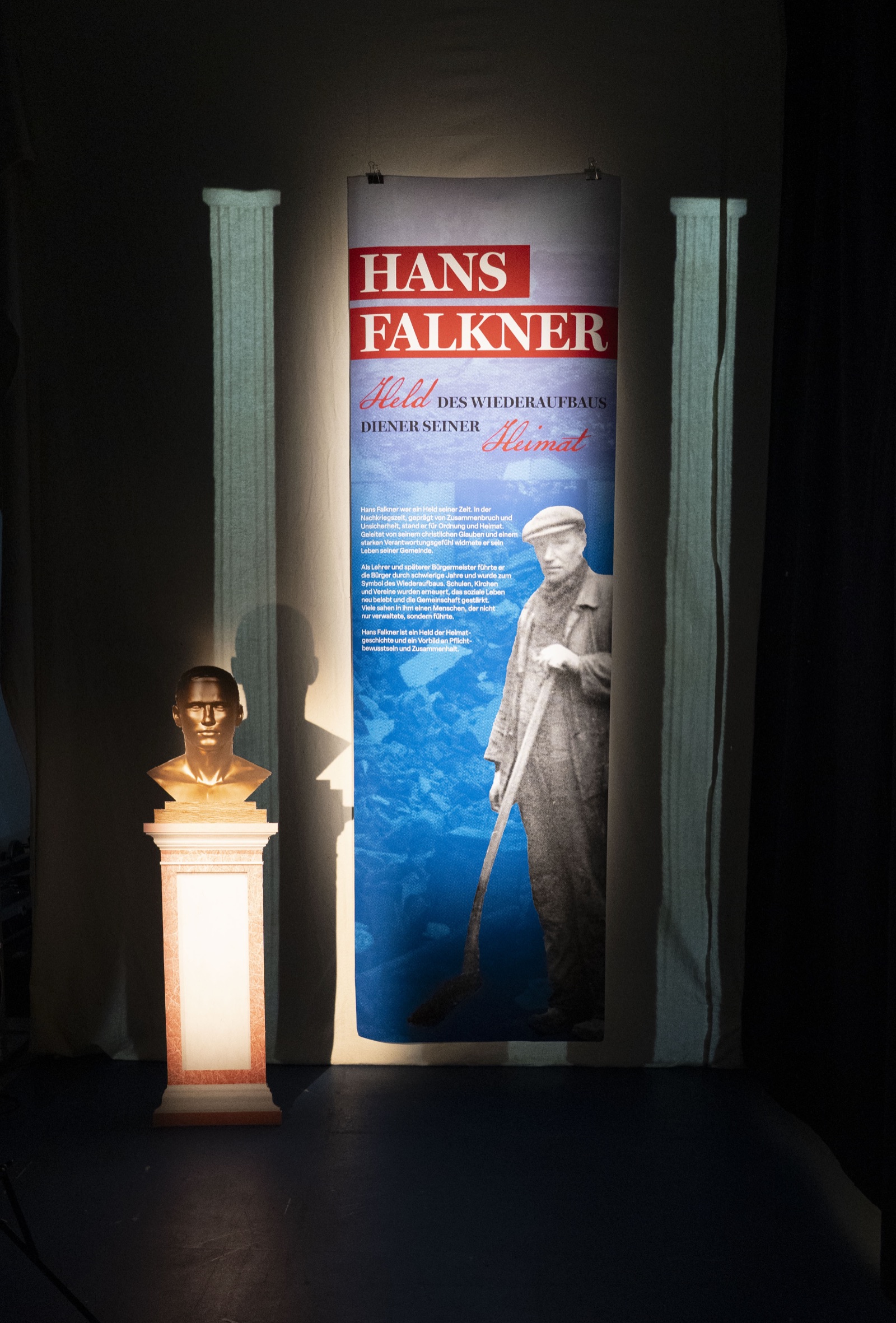
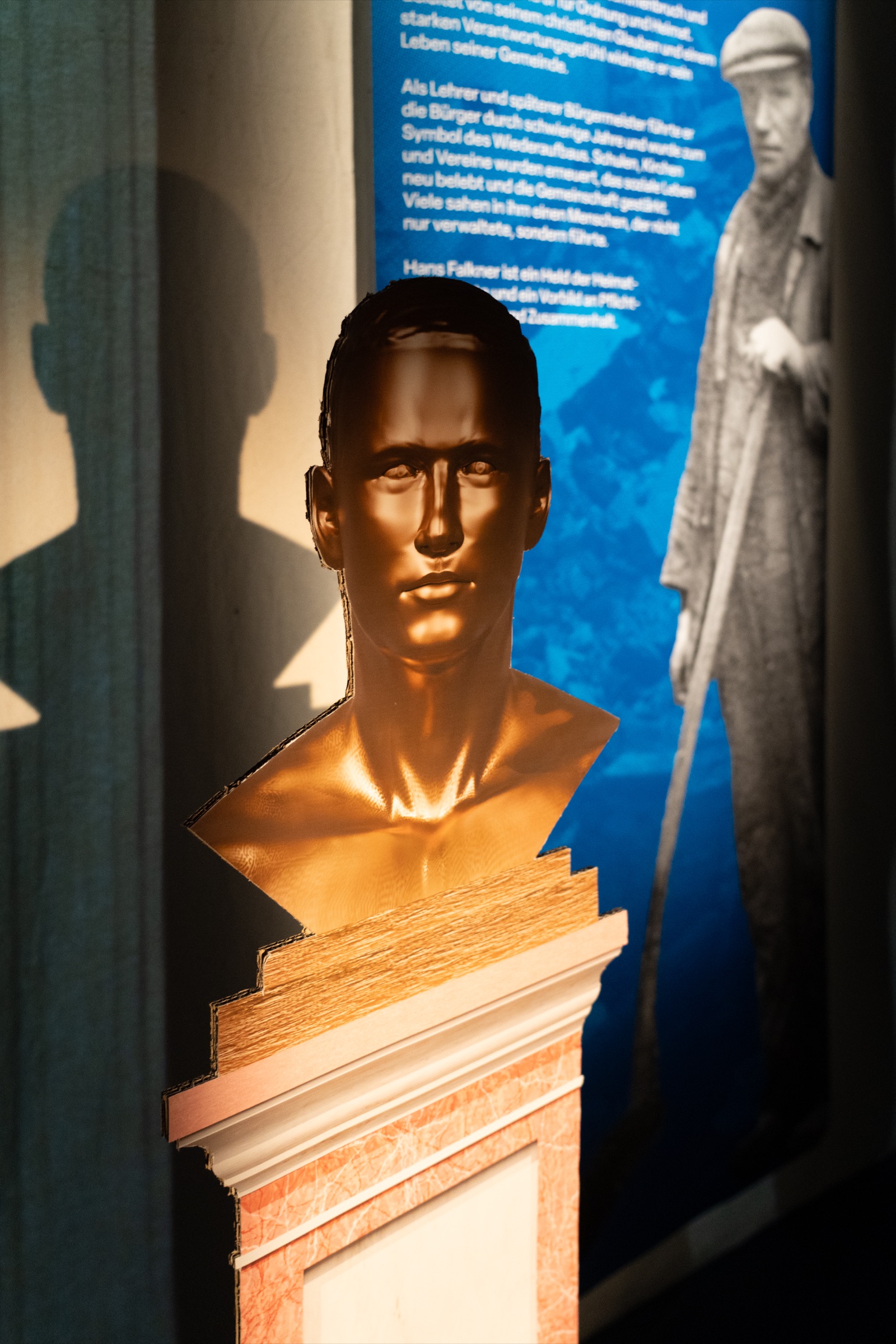
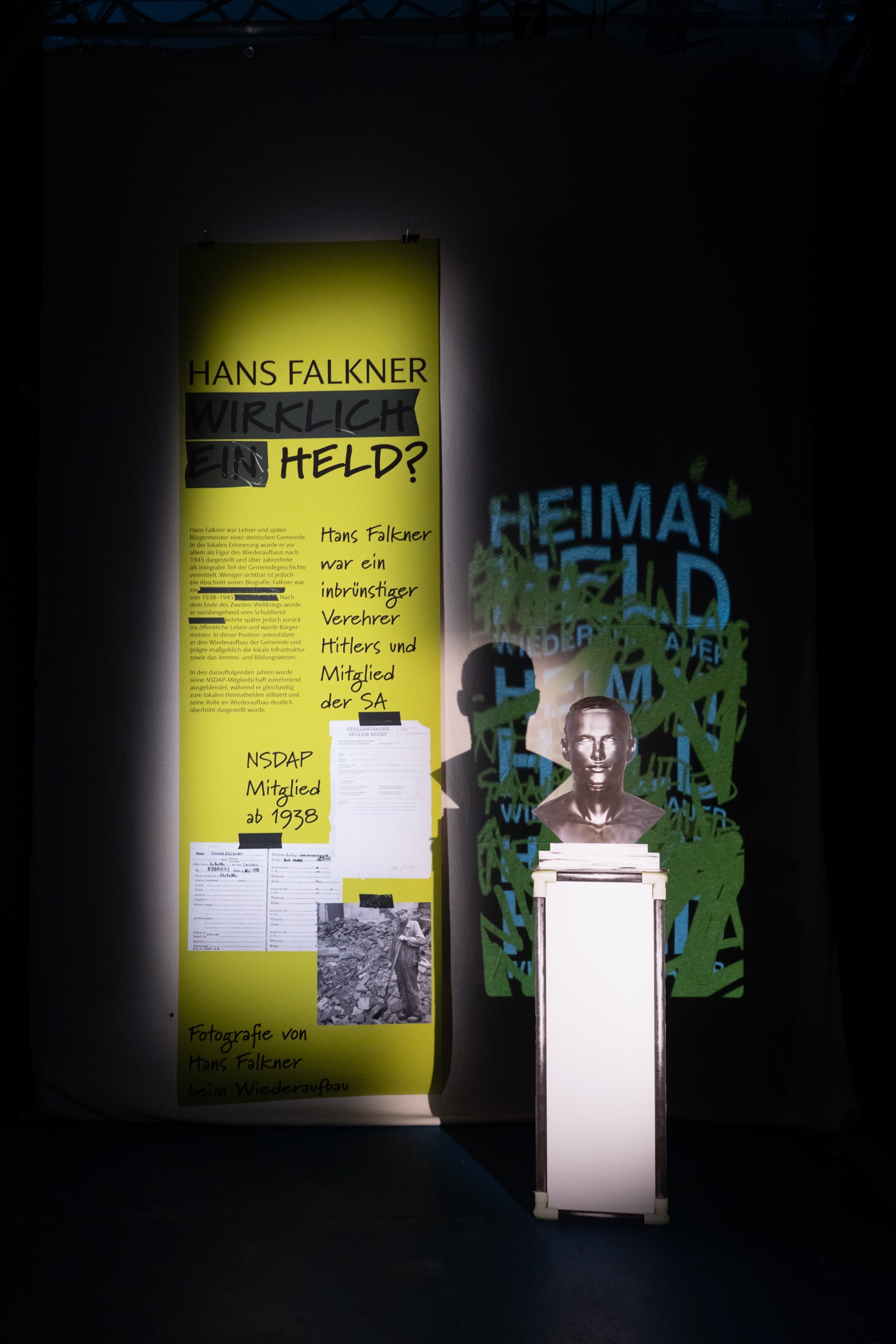
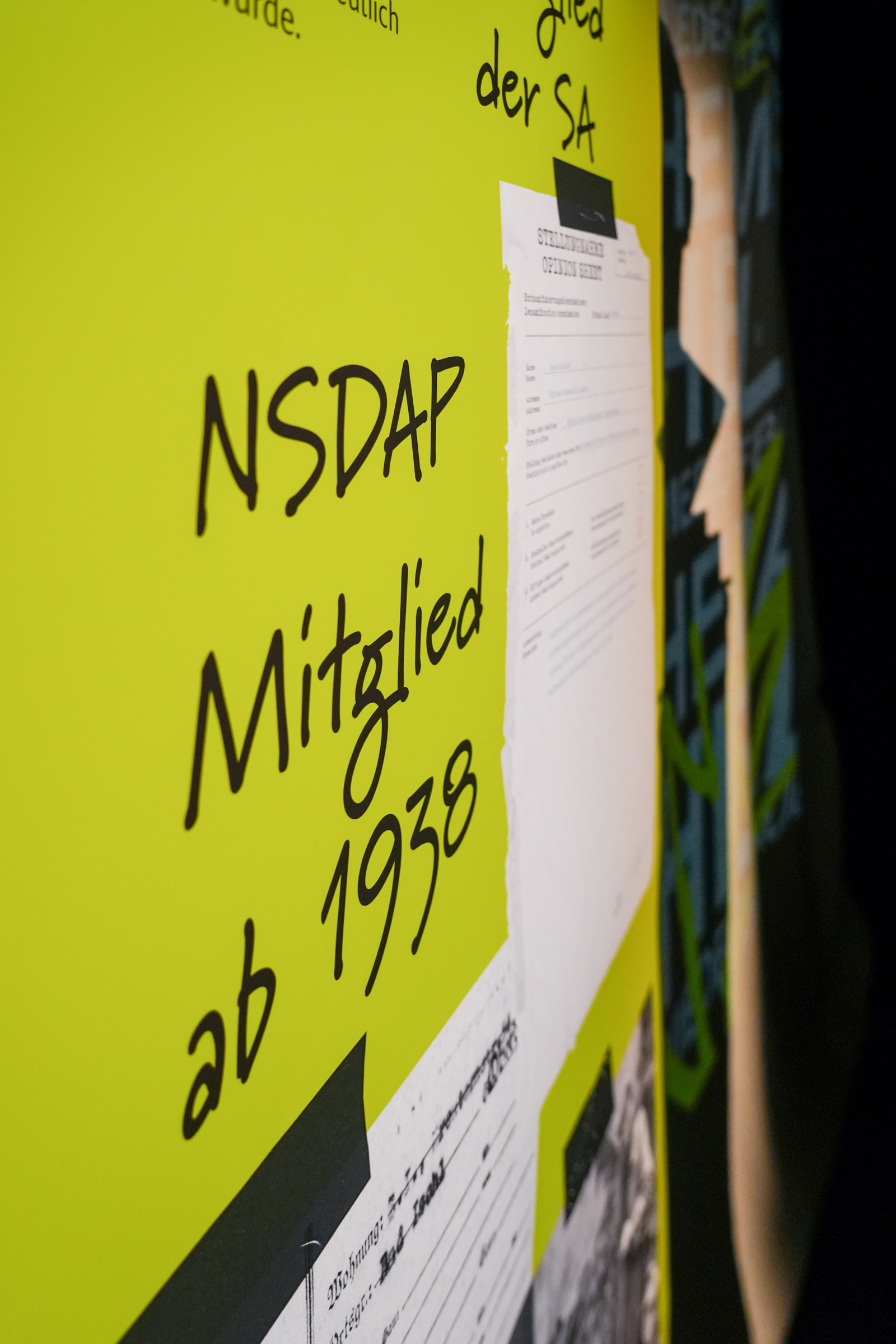
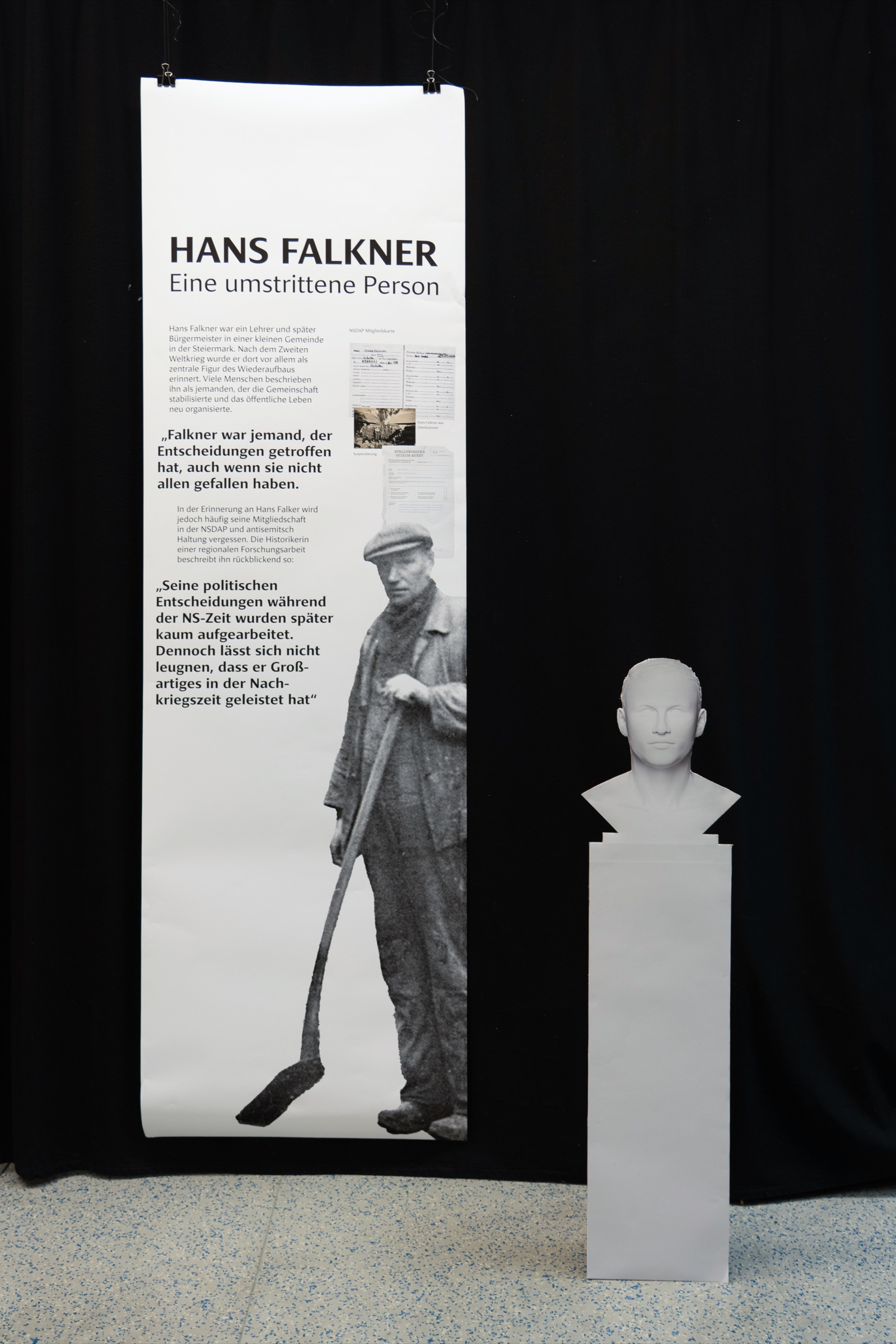
To test whether visitors actually recognise these design features, I created a fictional person, Hans Falkner. Based on the same ambiguous biography, I designed three versions of an exhibition about him. The nationalist-authoritarian version was based on the US Freedom Trucks, the critical version on the House of Austrian History in Vienna, and the ambivalent version on a white-cube aesthetic.
The test was qualitative and took place in the video studio at FH JOANNEUM. Participants walked through all three versions while thinking aloud and then answered a survey. The participants clearly recognised the nationalist version as right-wing and linked its red and blue colours to right-wing populist parties. Sound and imagery had the strongest effect on their perception.
Final
Concept
“The Power of Staging” brings together the findings from theory, analysis and testing. The exhibition asks how design is used to communicate, strengthen and construct political narratives, and it questions the museum as an institution. Its aim is to make visitors, especially young people, aware of how design and narratives work, so they can recognise political staging and question it.
Narrative Structure
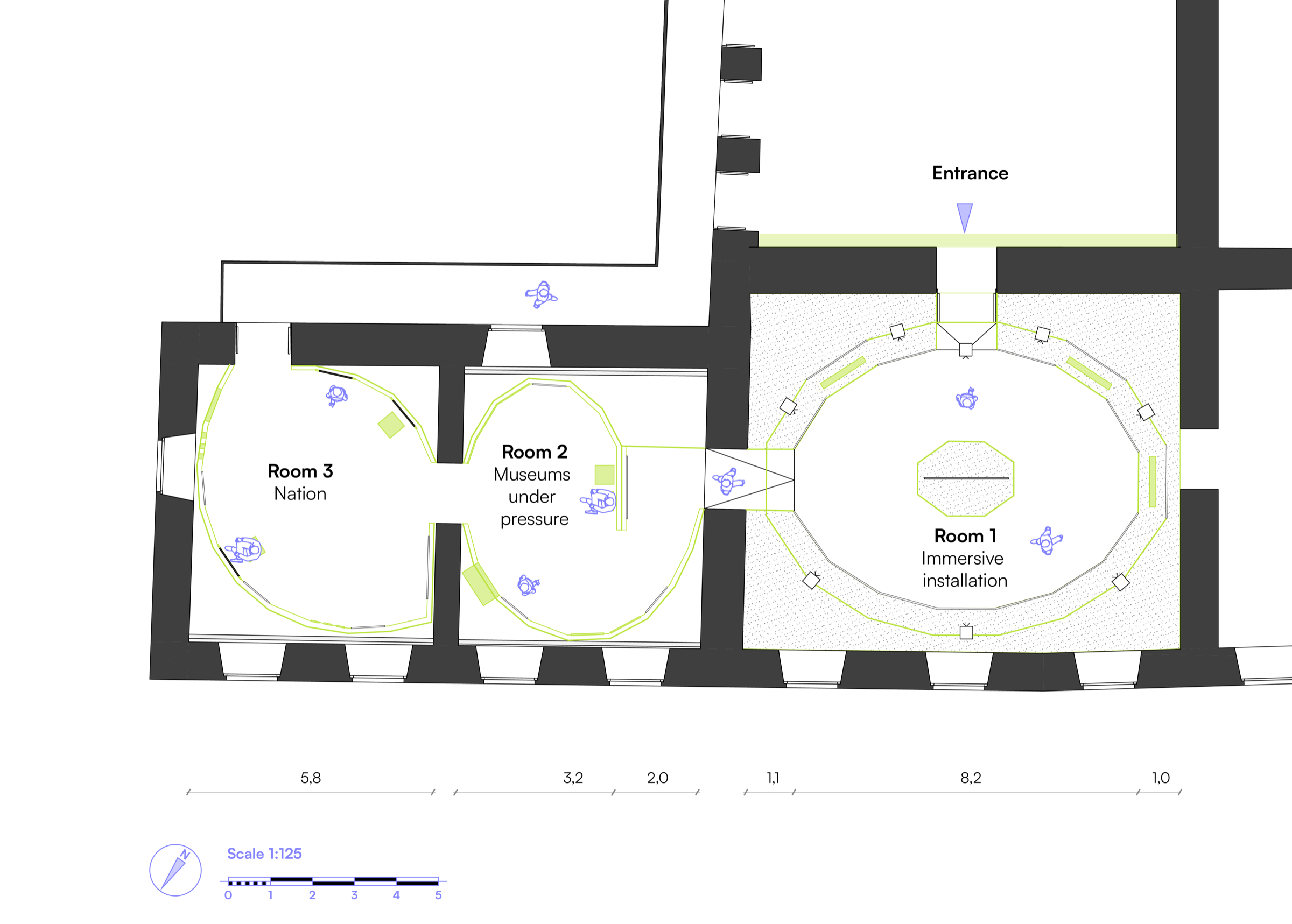
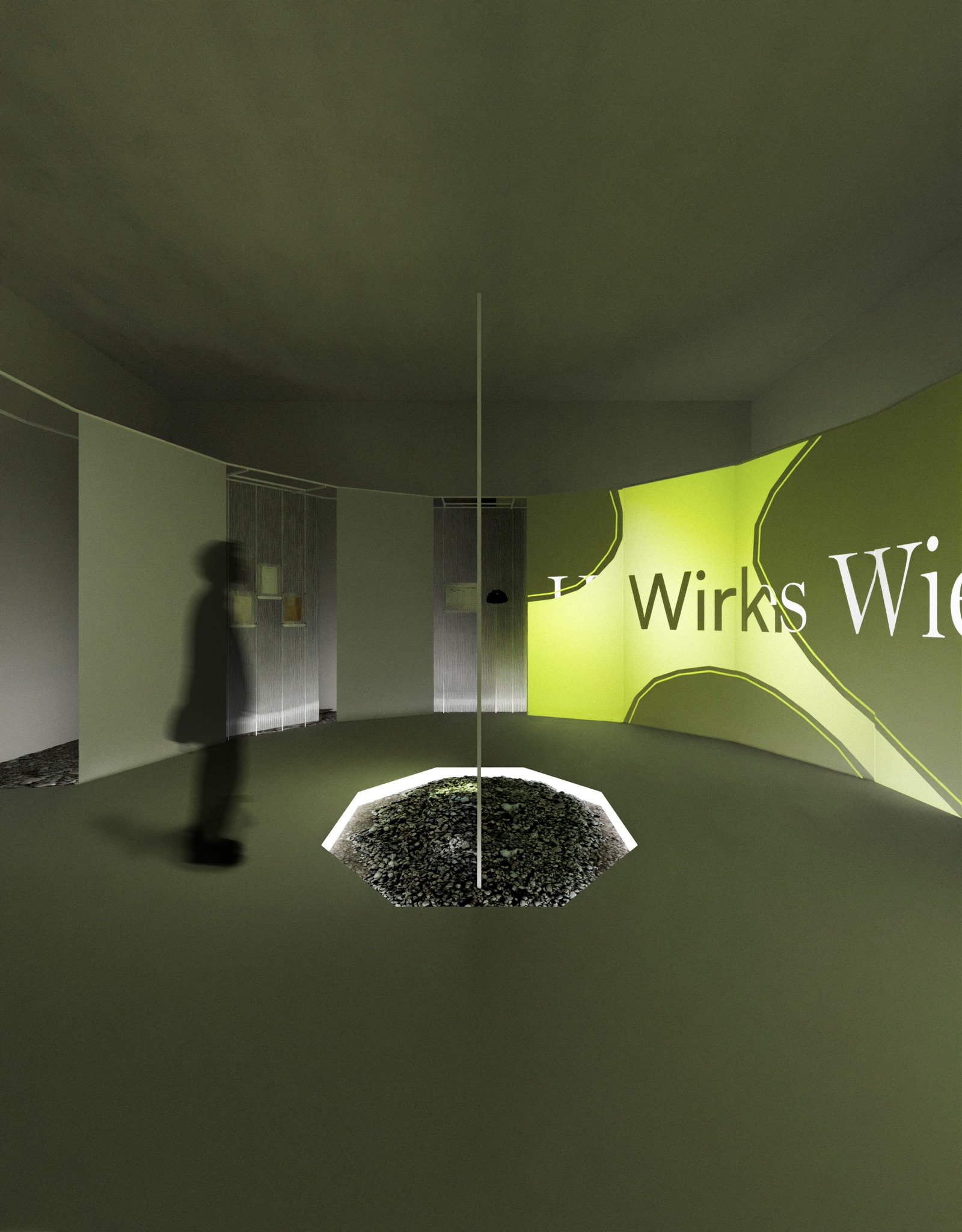
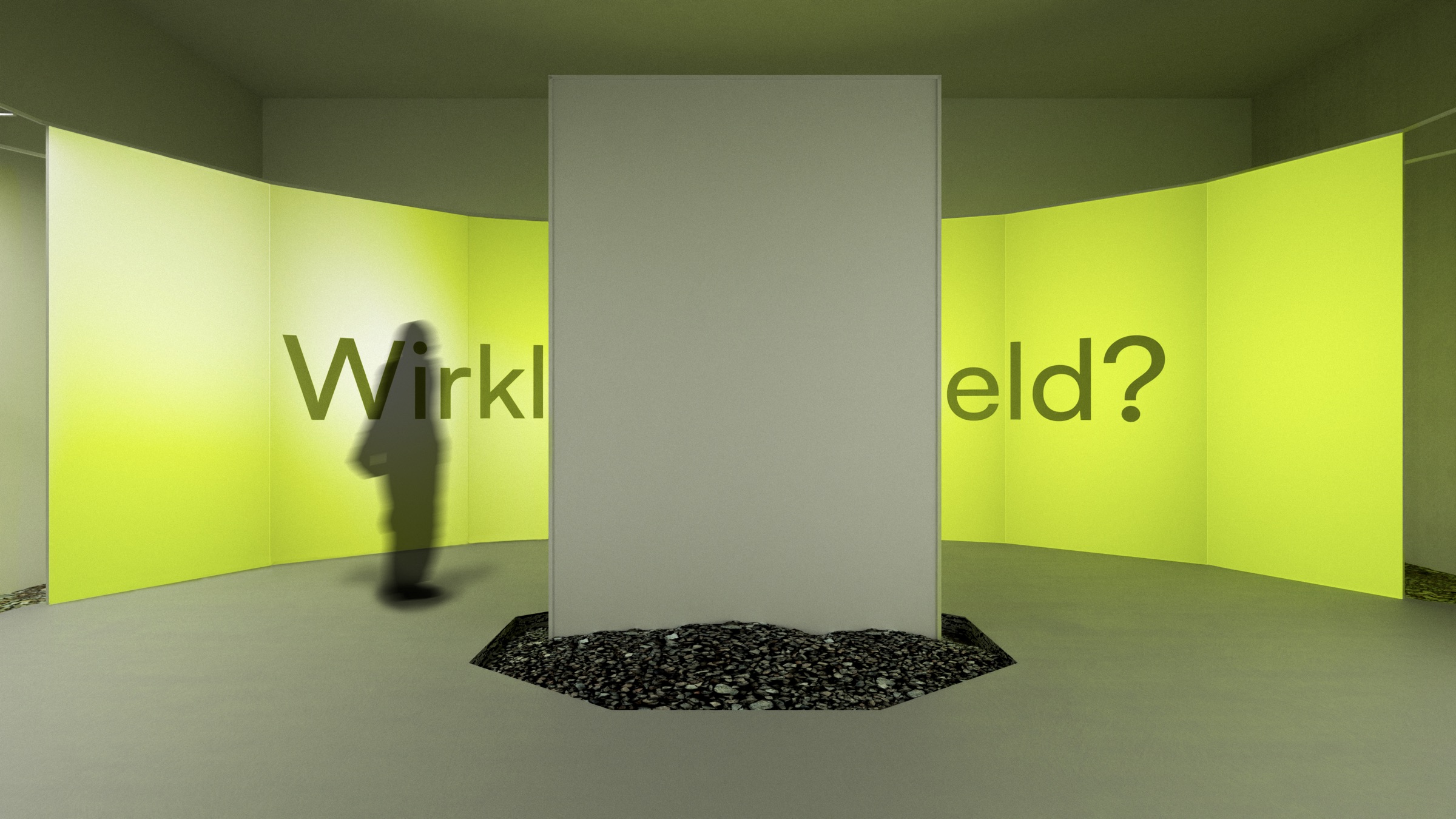
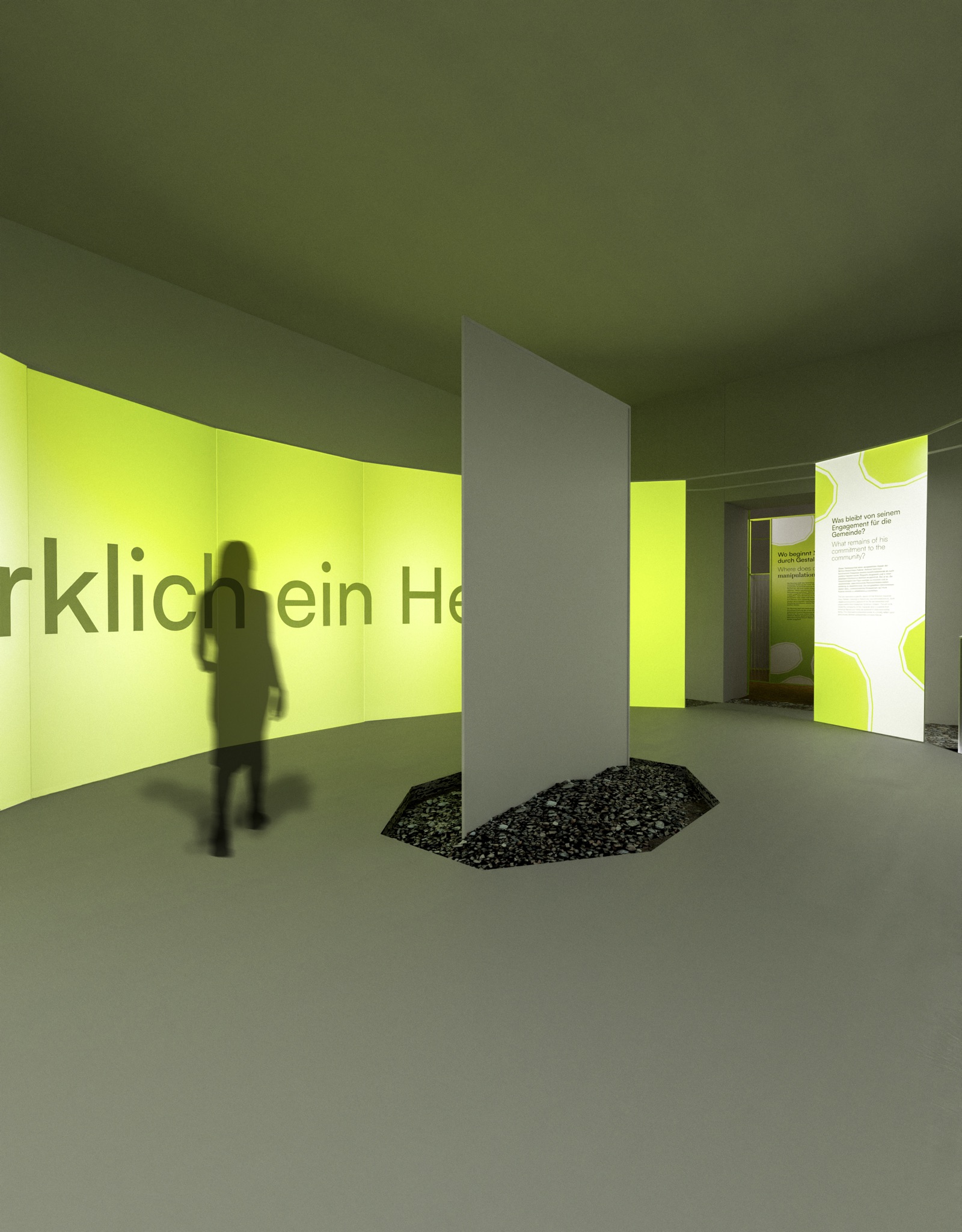
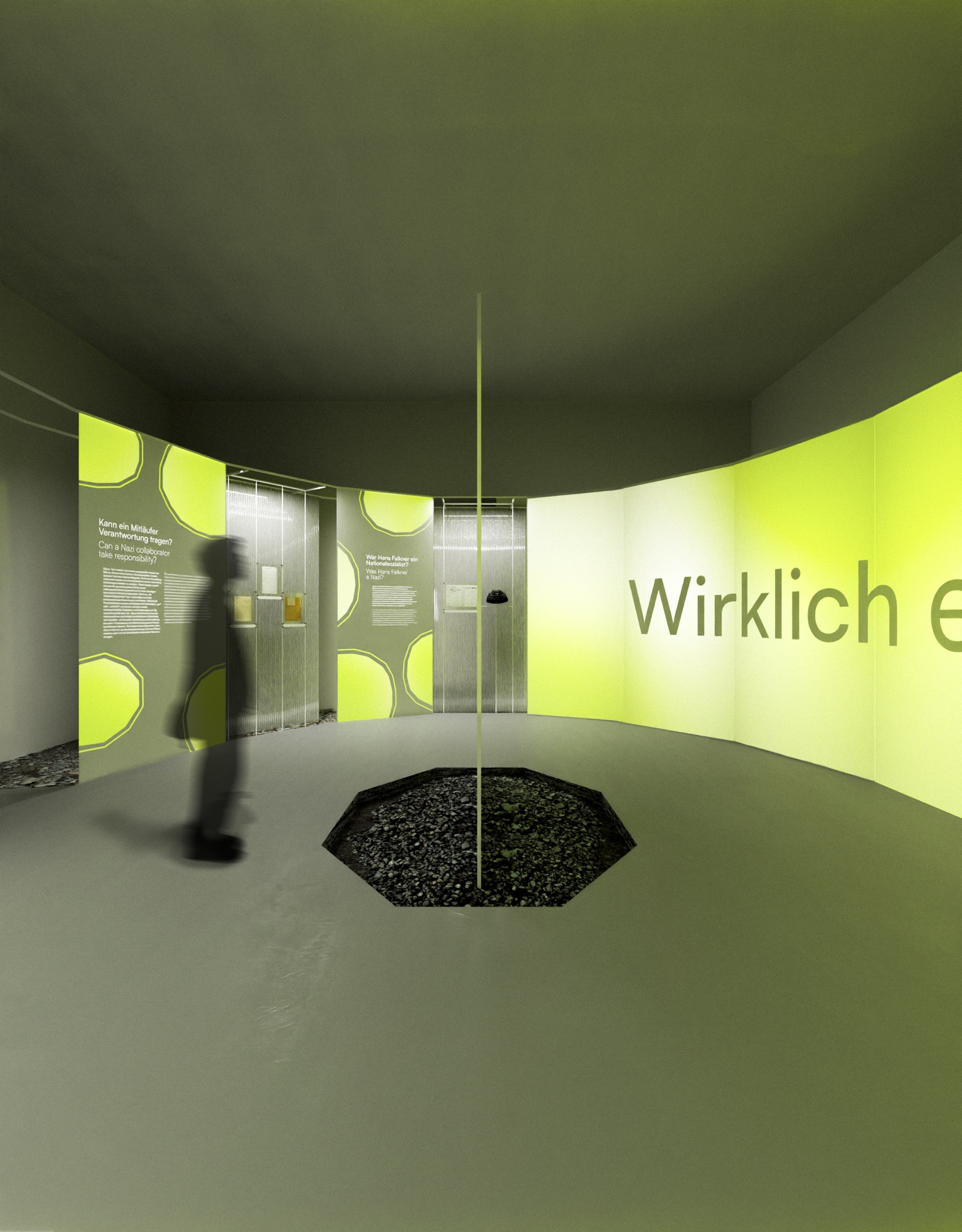
The exhibition is designed for three rooms on the second floor of the Graz Museum. The route is linear, so visitors would pass through the rooms in a fixed order. This follows the narrative structure: the first room is immersive and emotional, while the second and third rooms are factual and analytical and present their content in a more traditional way.
Visual Identity
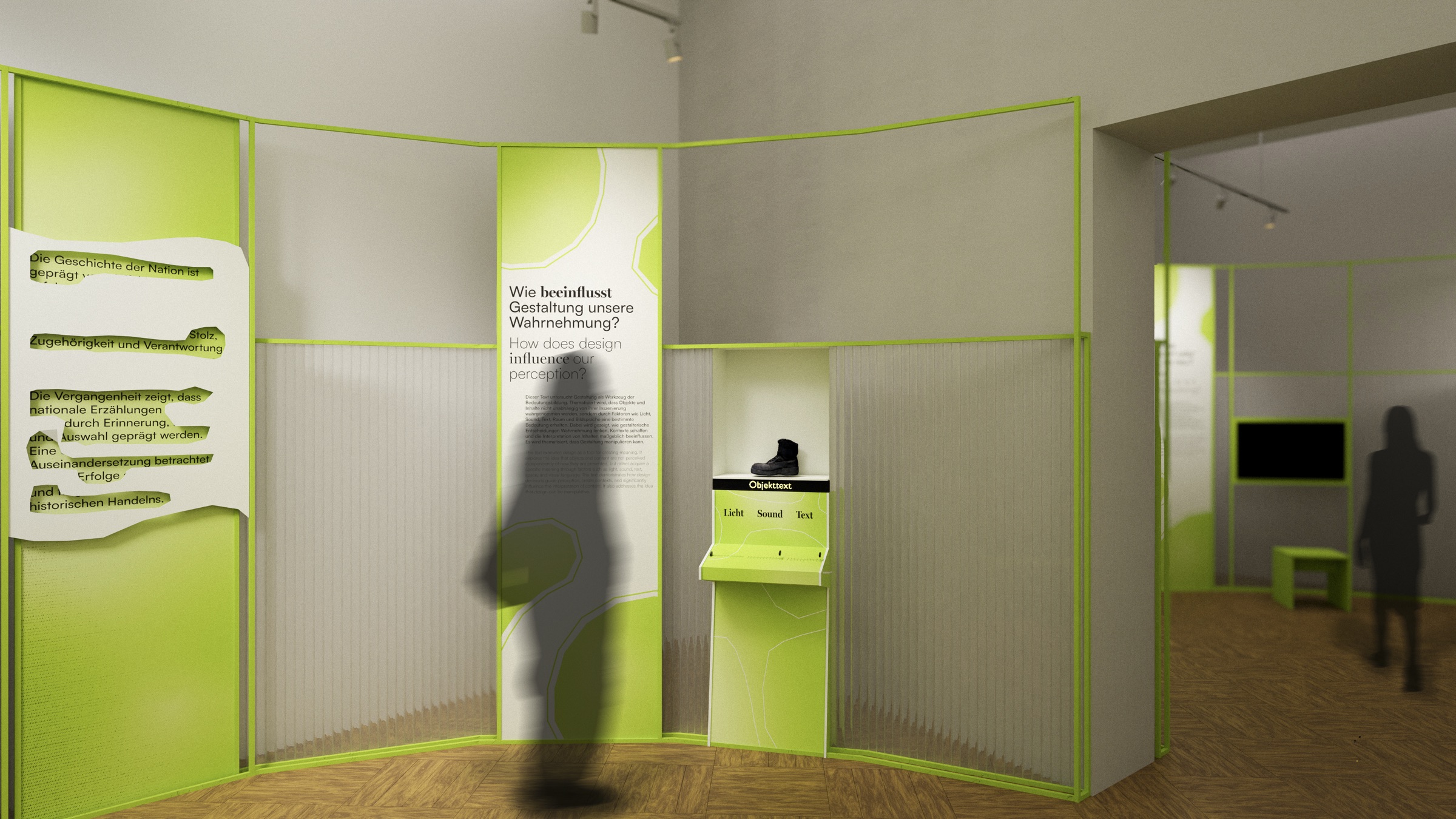
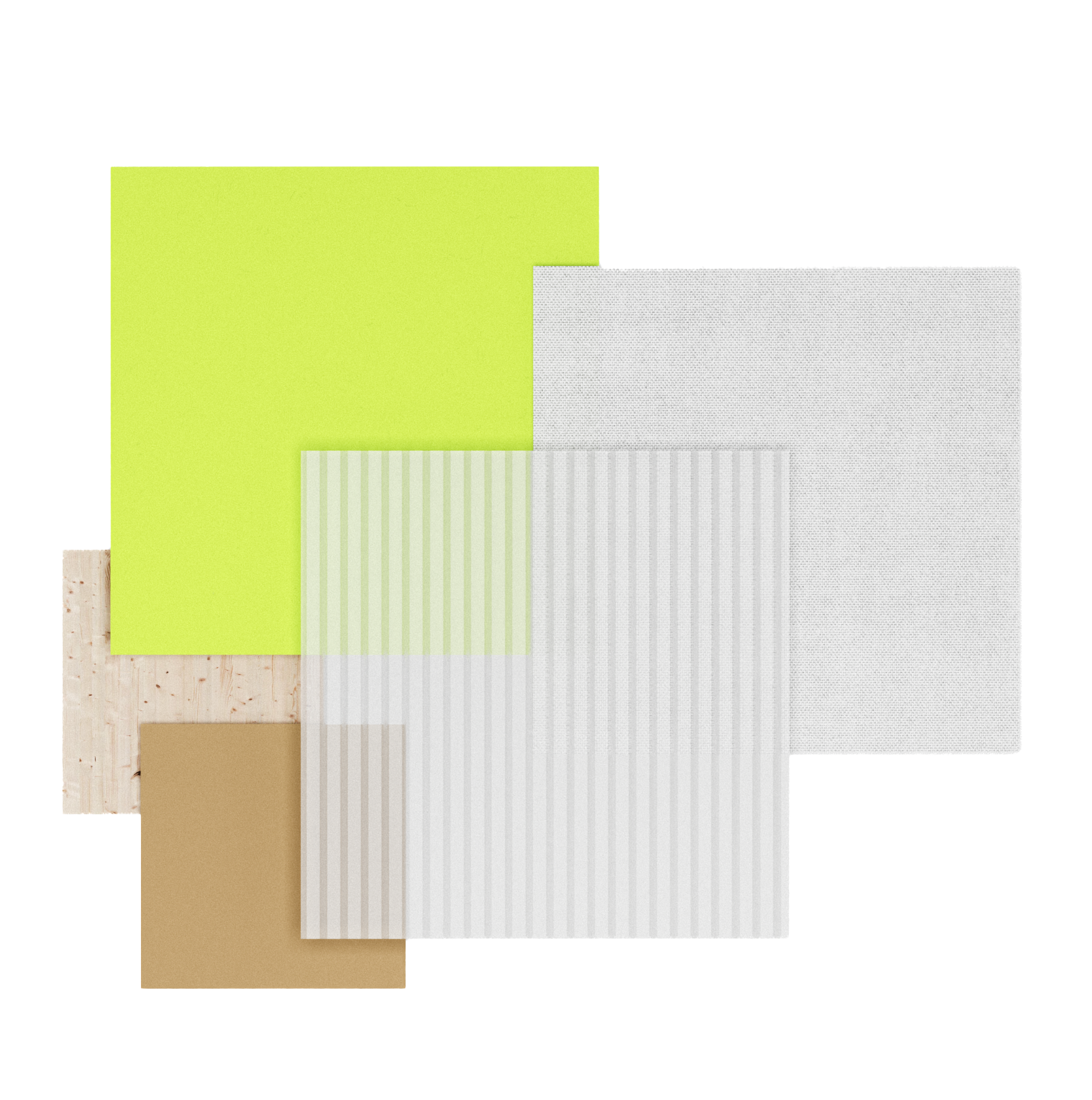
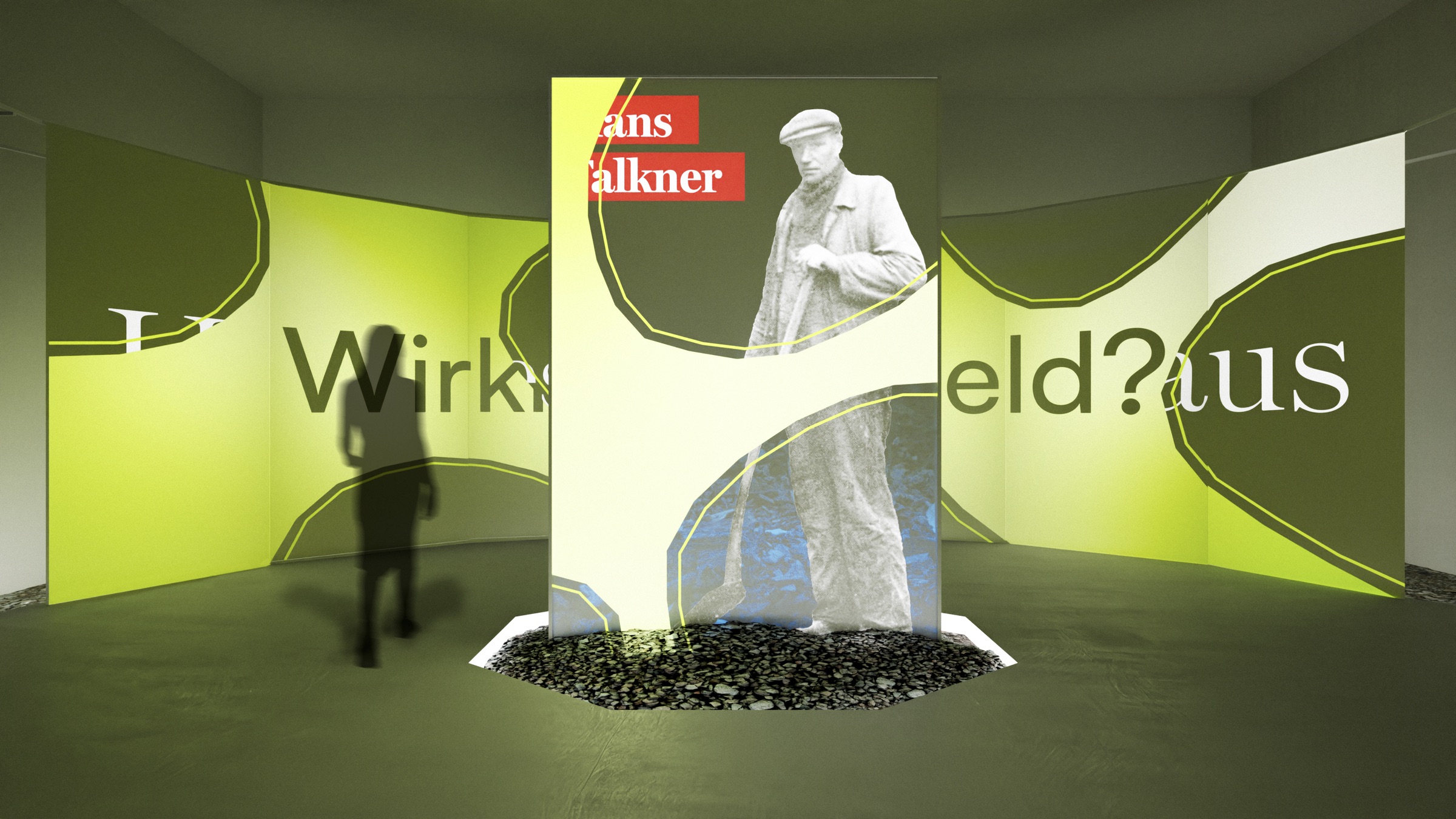
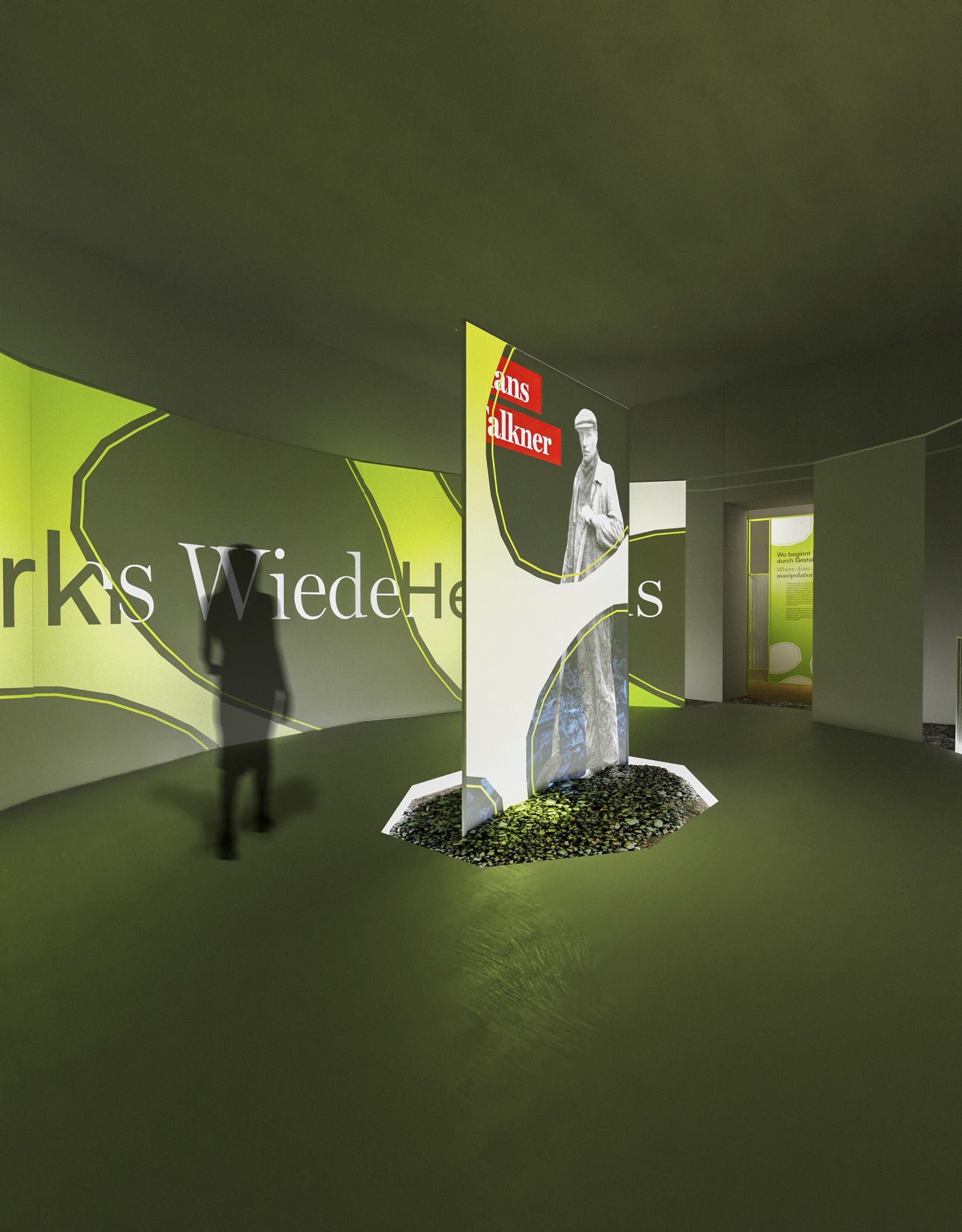
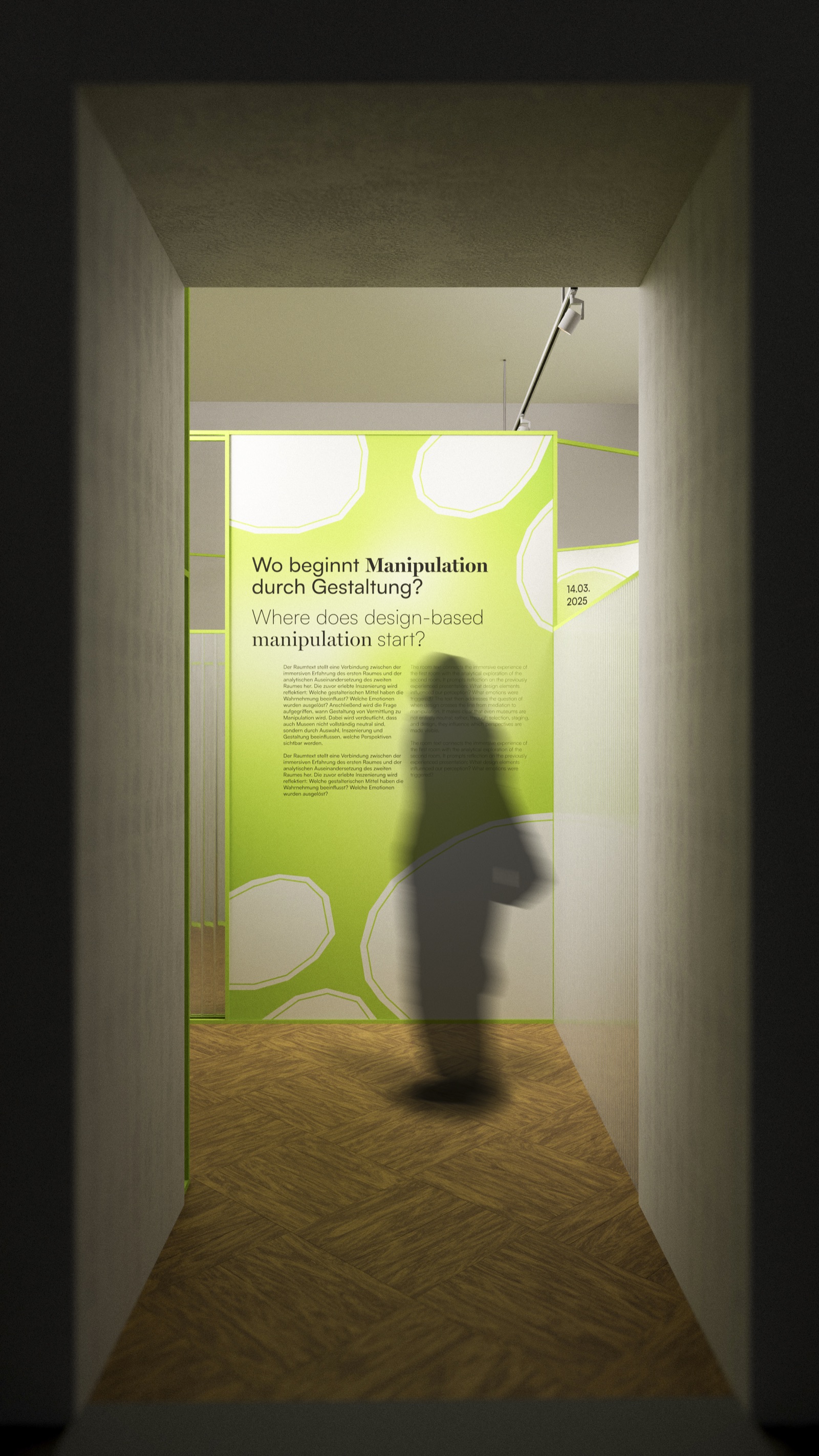
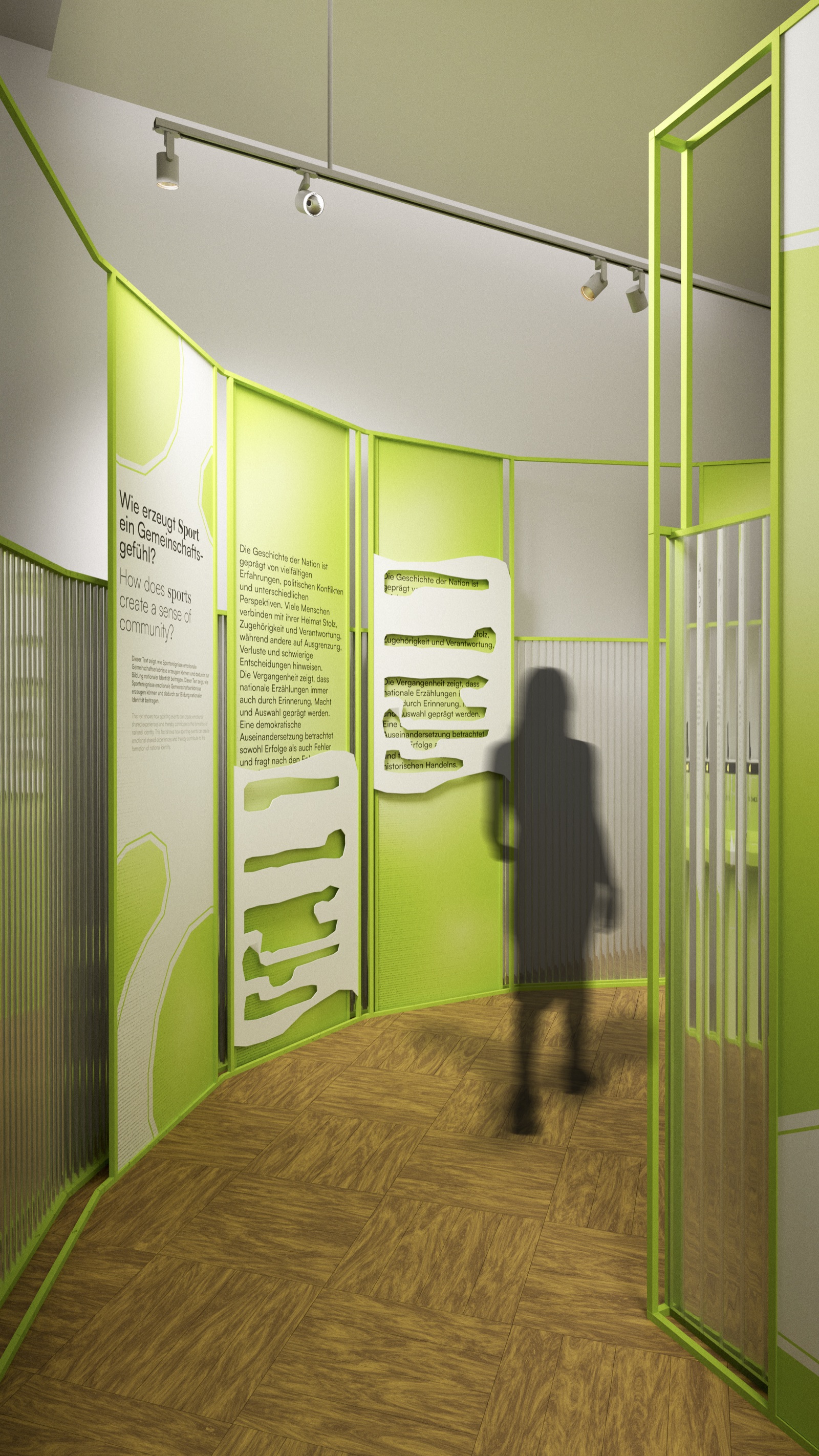
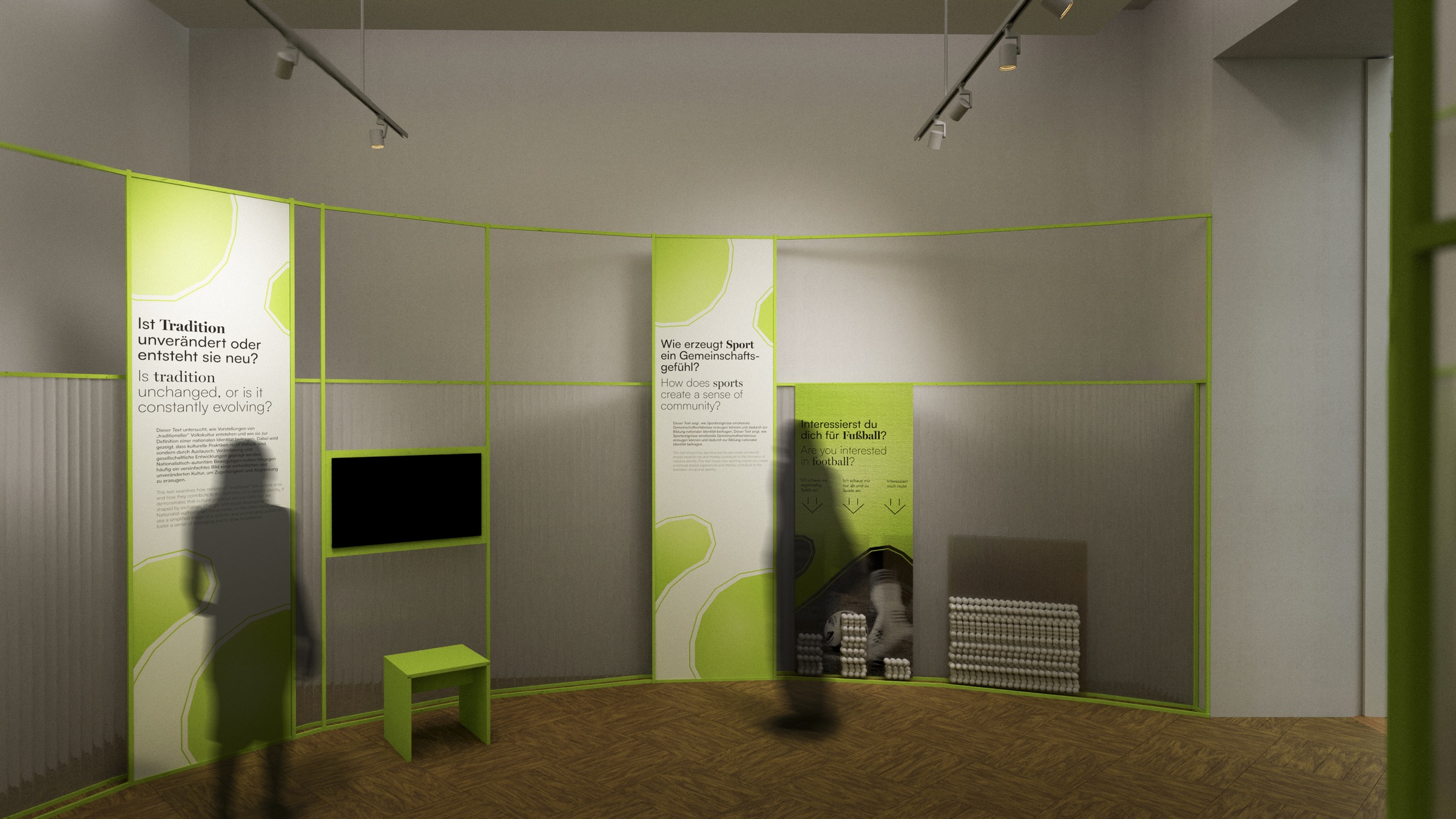
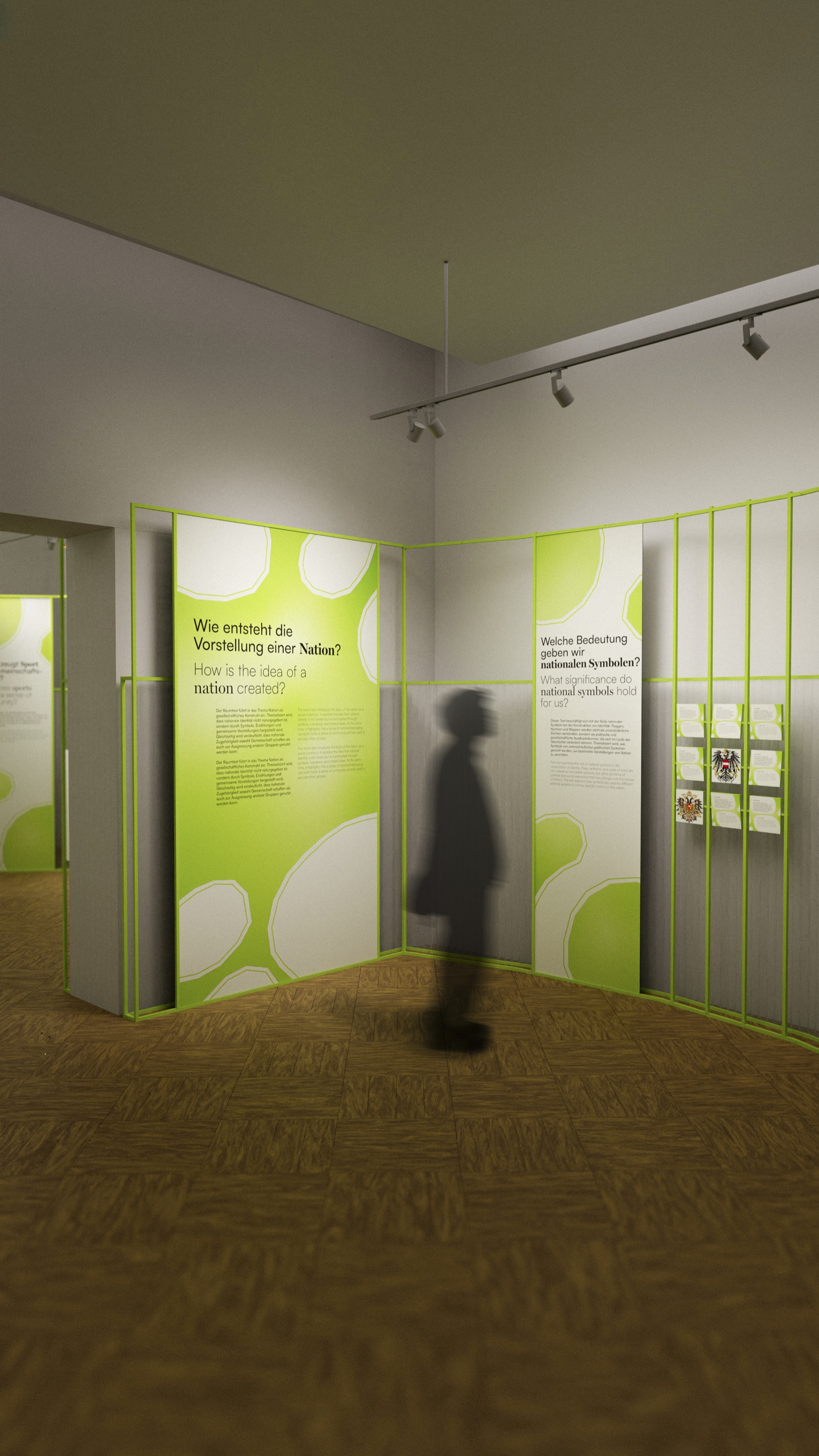
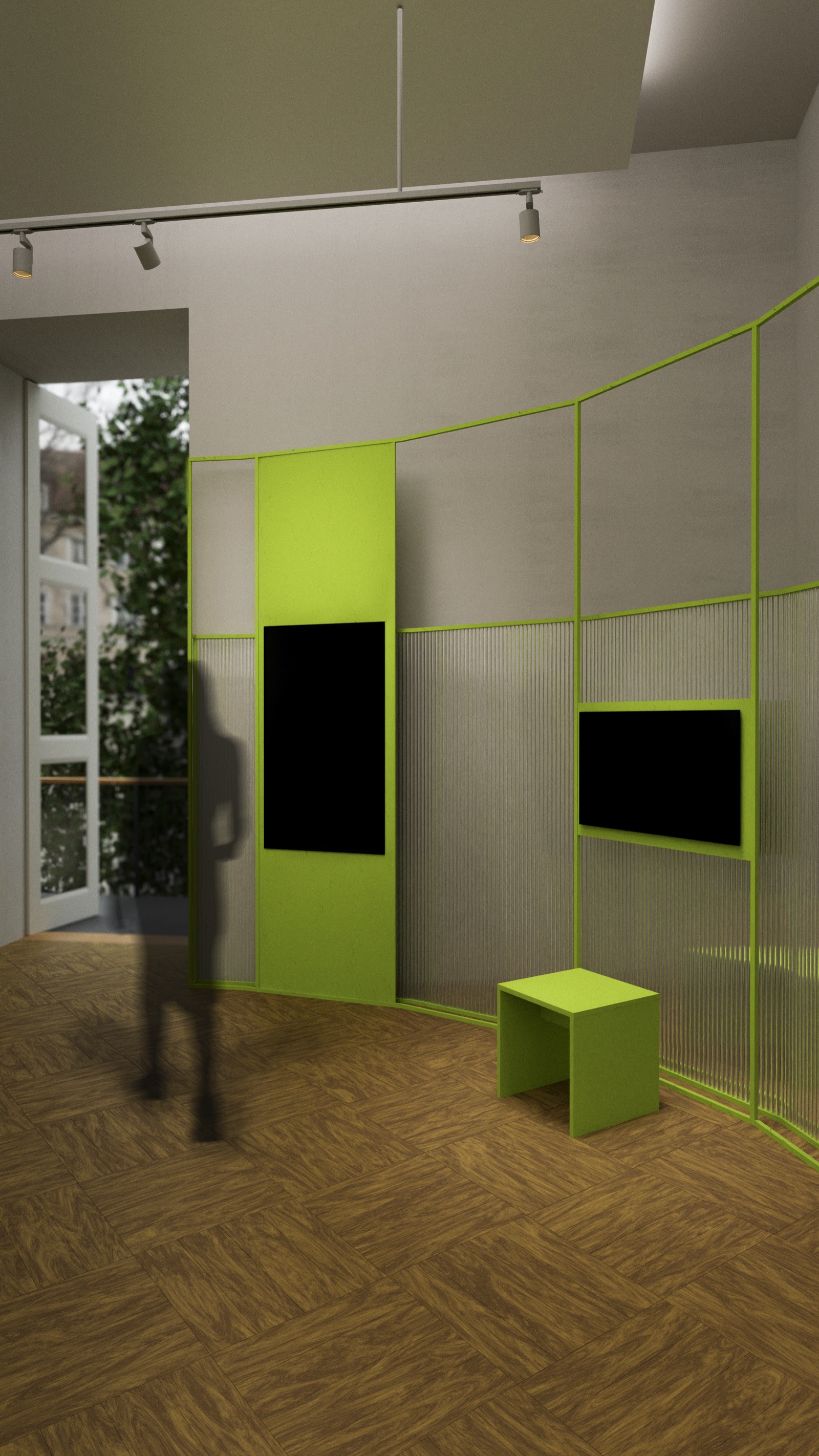
I deliberately avoided the design features of nationalist-authoritarian exhibitions and chose materials and colours that set a counterpoint to them. The main material is clear polycarbonate. It stands for transparency: the exhibition shows its own design decisions instead of hiding them. Light green serves as the accent colour.
Typography is the one exception. I combined a traditional serif typeface with a sans serif on purpose. The serif stands for nationalist-authoritarian design, the sans serif for a democratic design language. This shows on a typographic level that design can do very different things depending on the political context.
Room 1
Immersive Installation
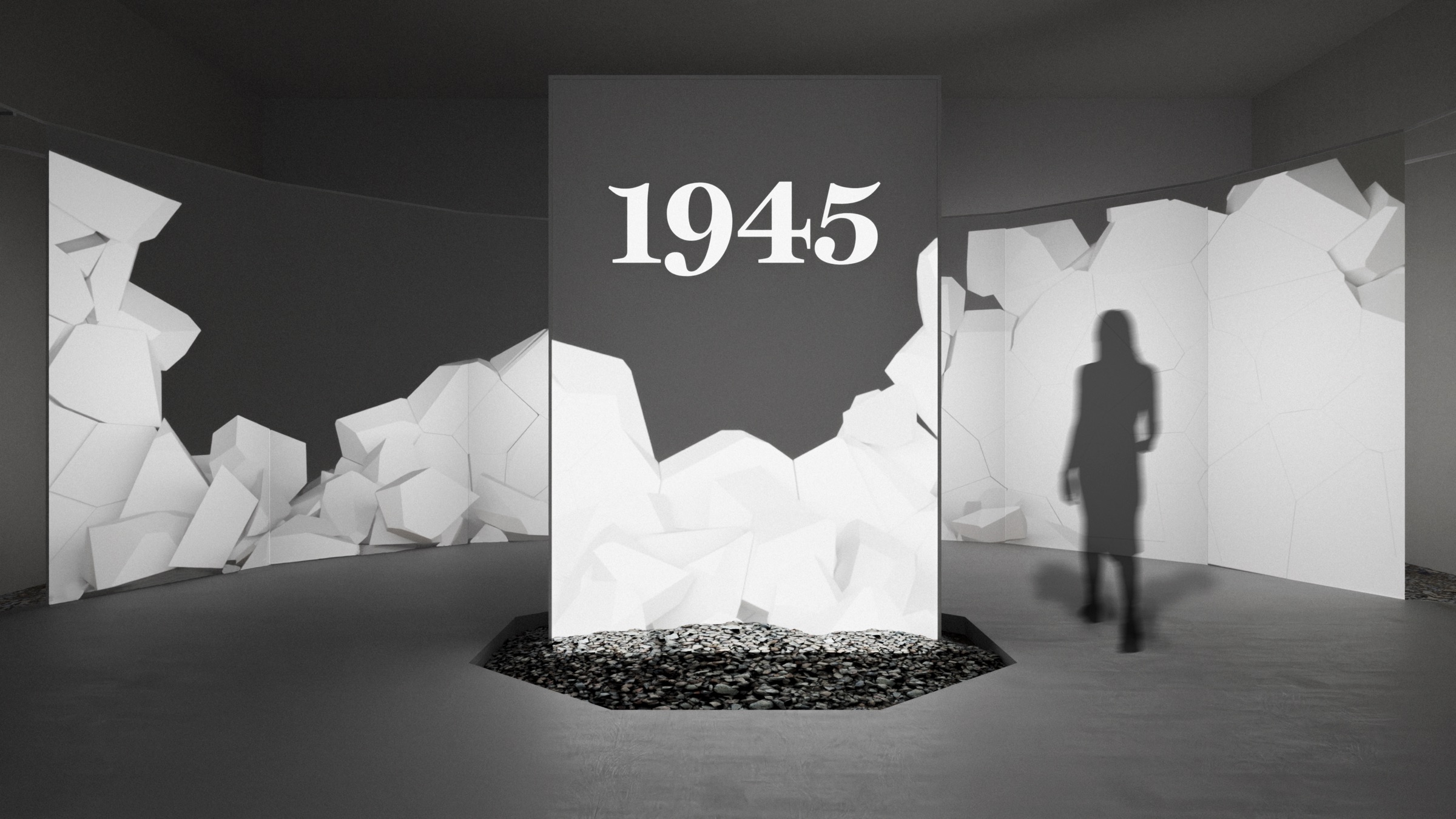
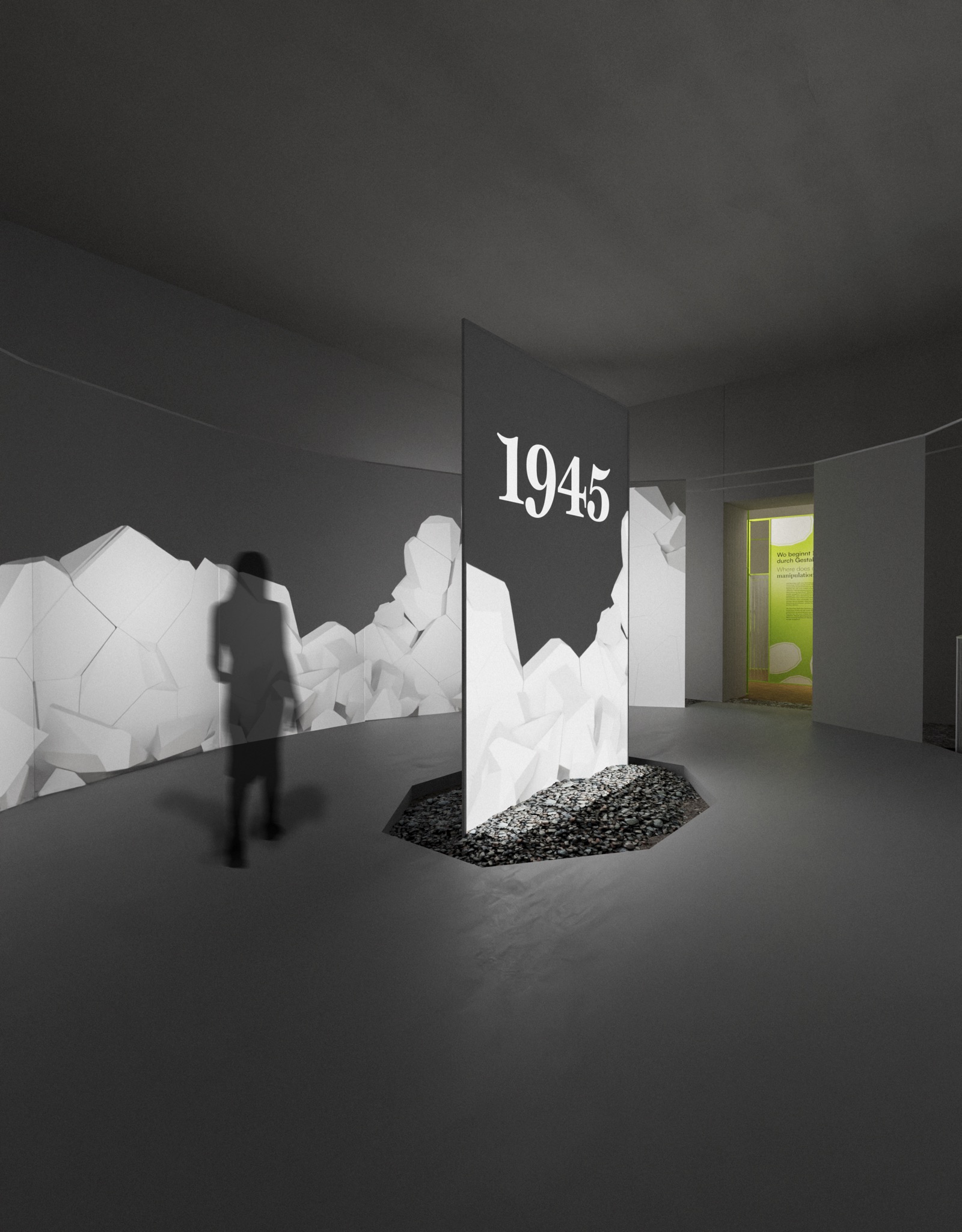
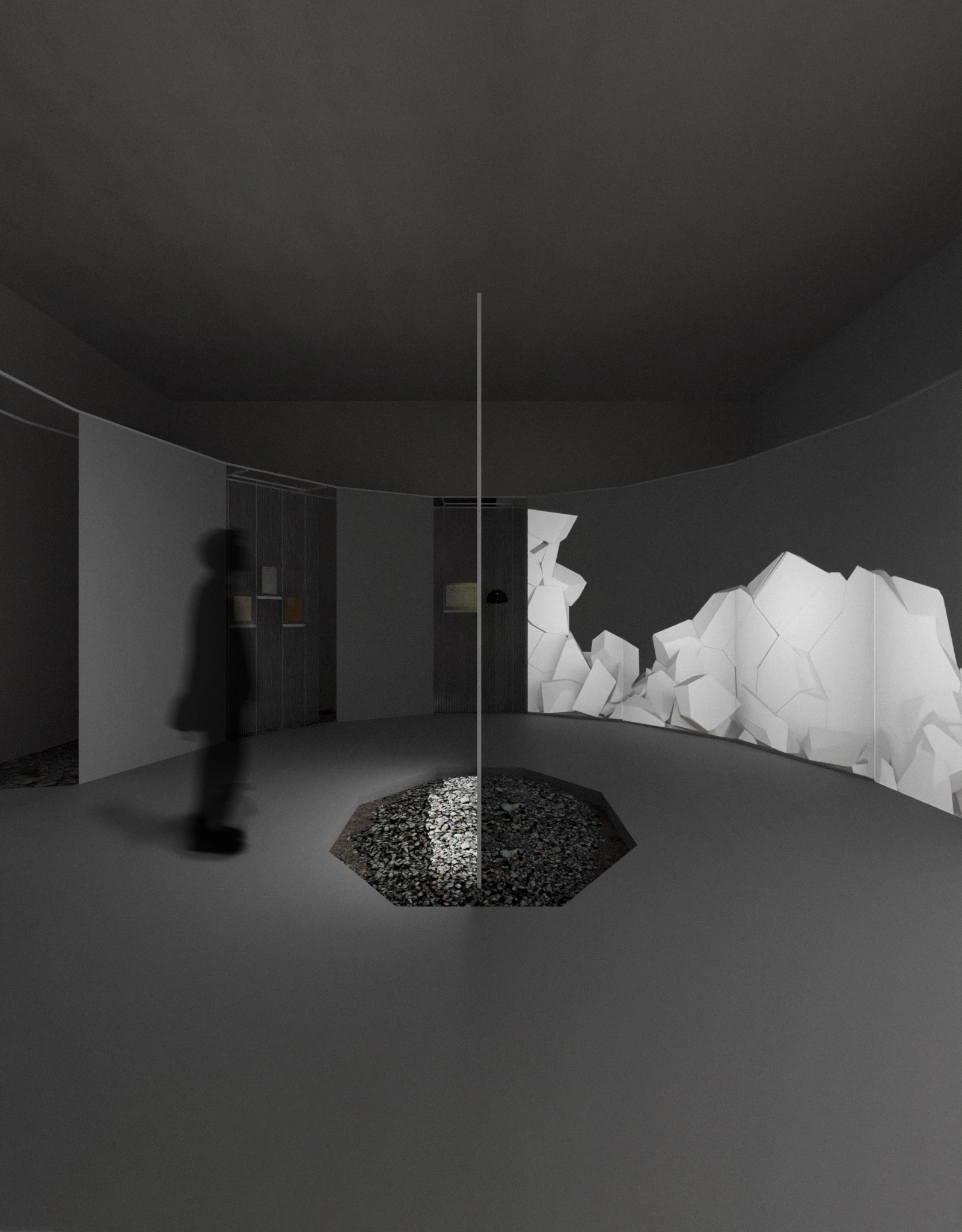
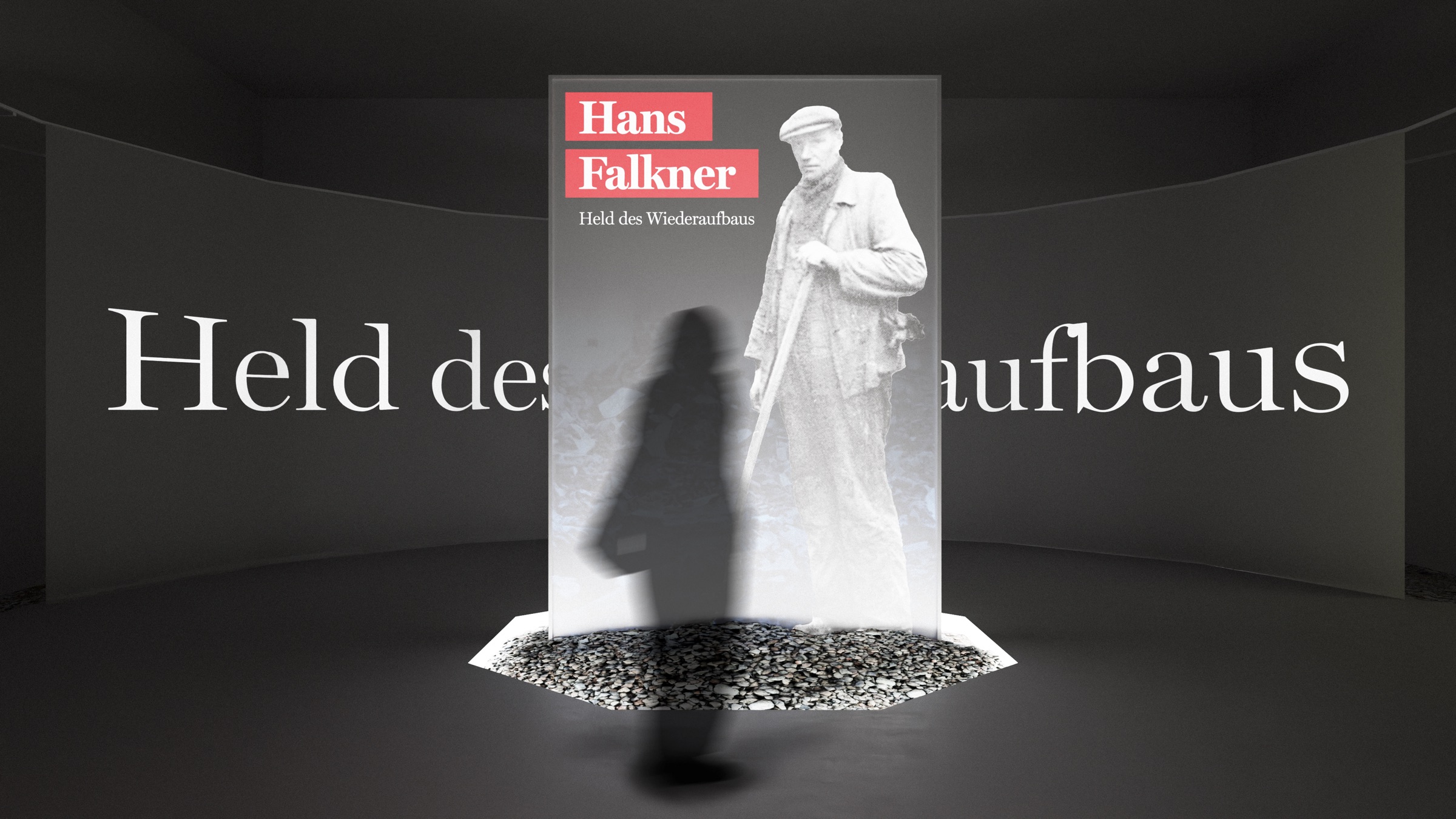
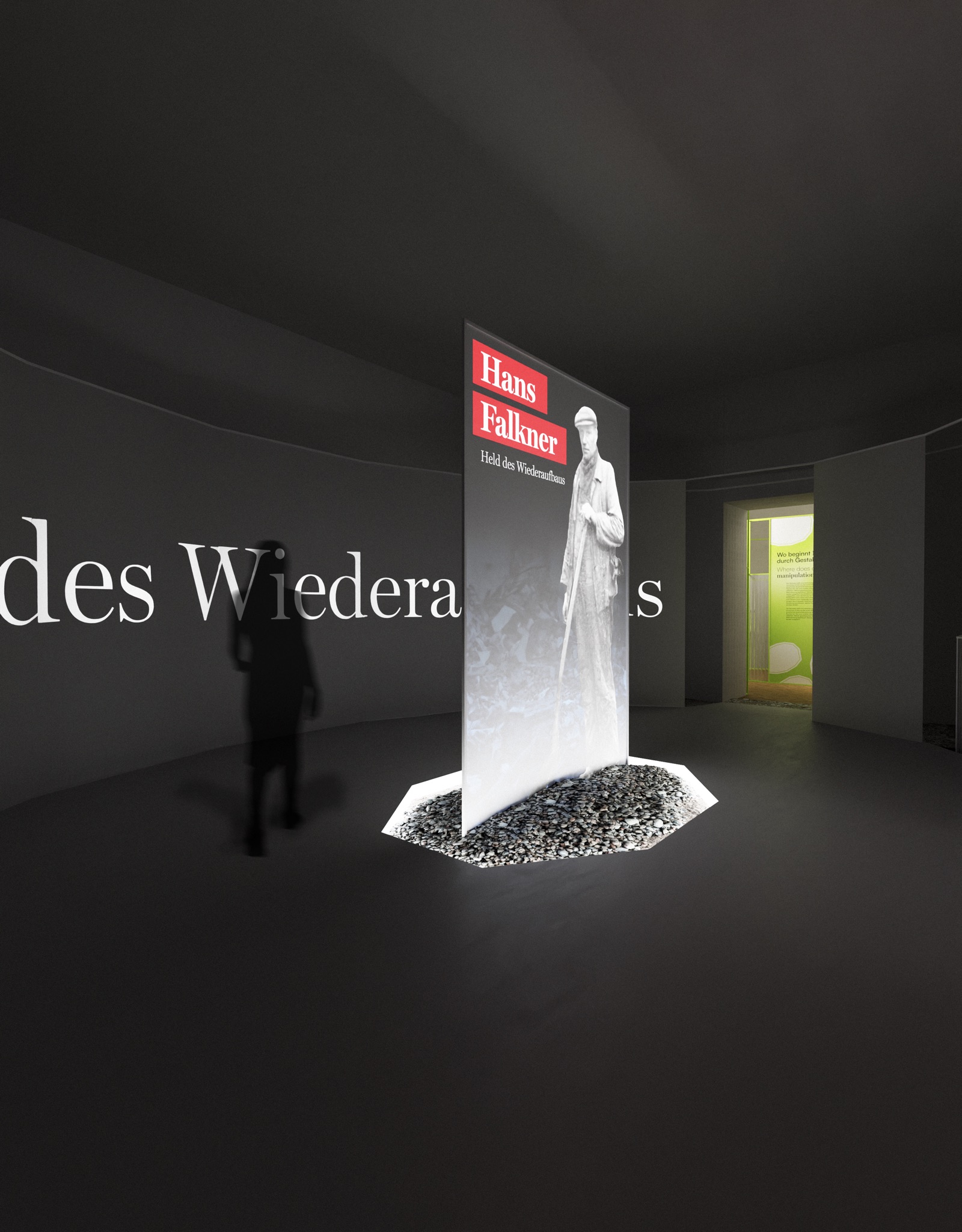
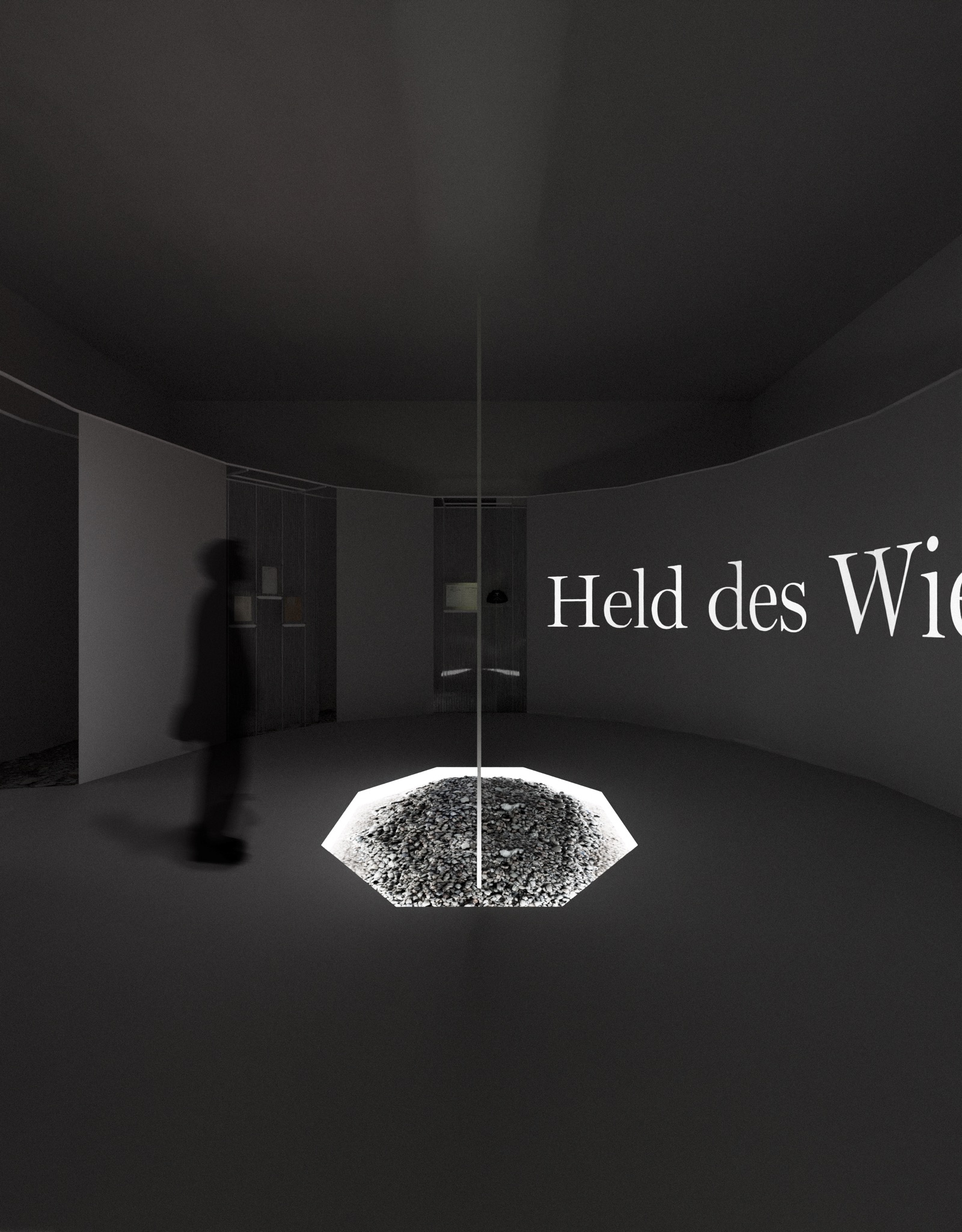
In the first room, design itself becomes the subject of the exhibition. Visitors experience directly how design and narrative change the way content is perceived. The story is built around the fictional Hans Falkner. The room is white and grey, and all colour comes from projections, so the atmosphere can change without changing the room. The installation begins with a nationalist-authoritarian narrative that presents Falkner as the hero of Austria’s post-war rebuilding. This narrative is then disrupted and questioned, until a critical counter-narrative reveals his Nazi past.
Room 2
Museums under Pressure
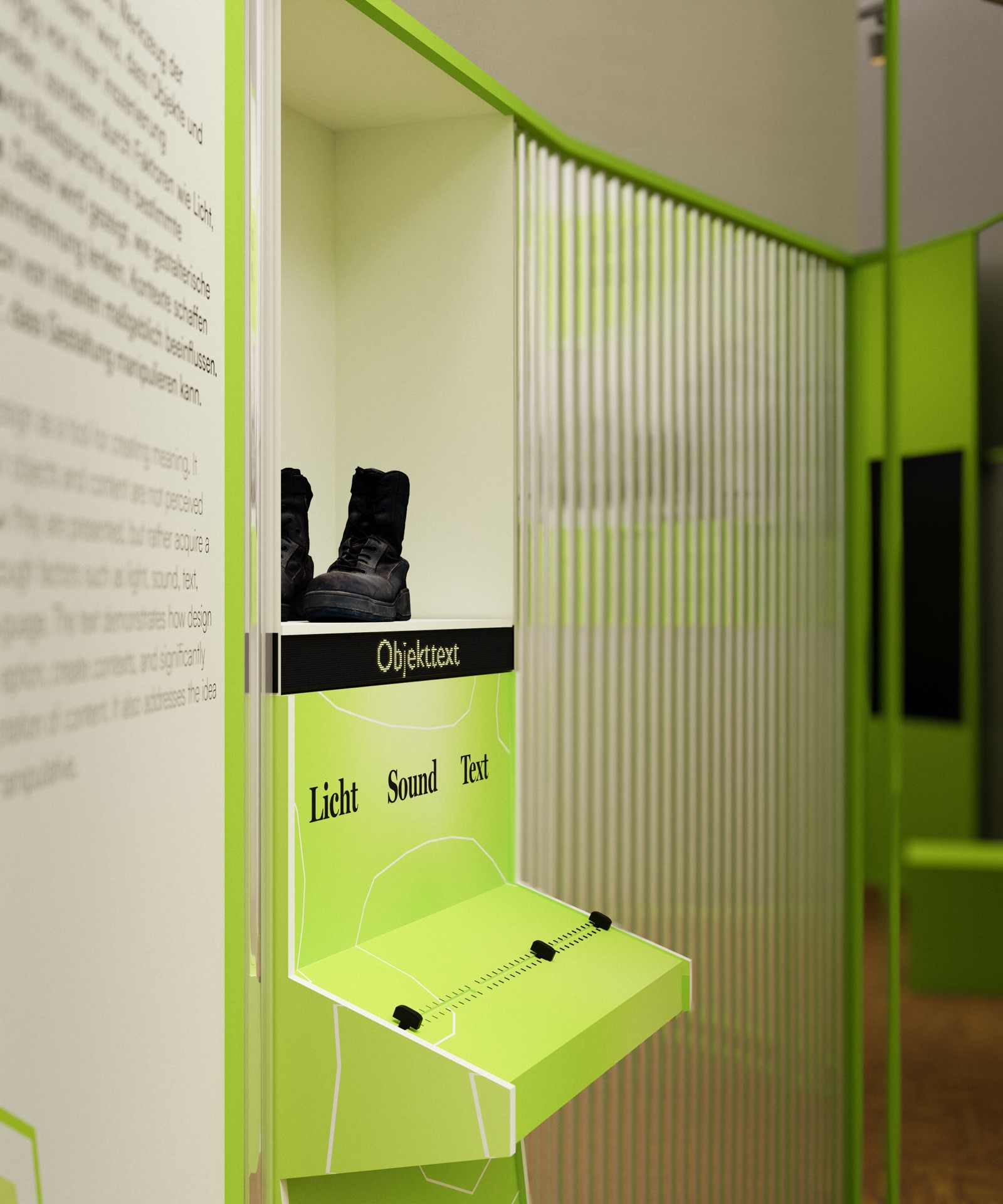
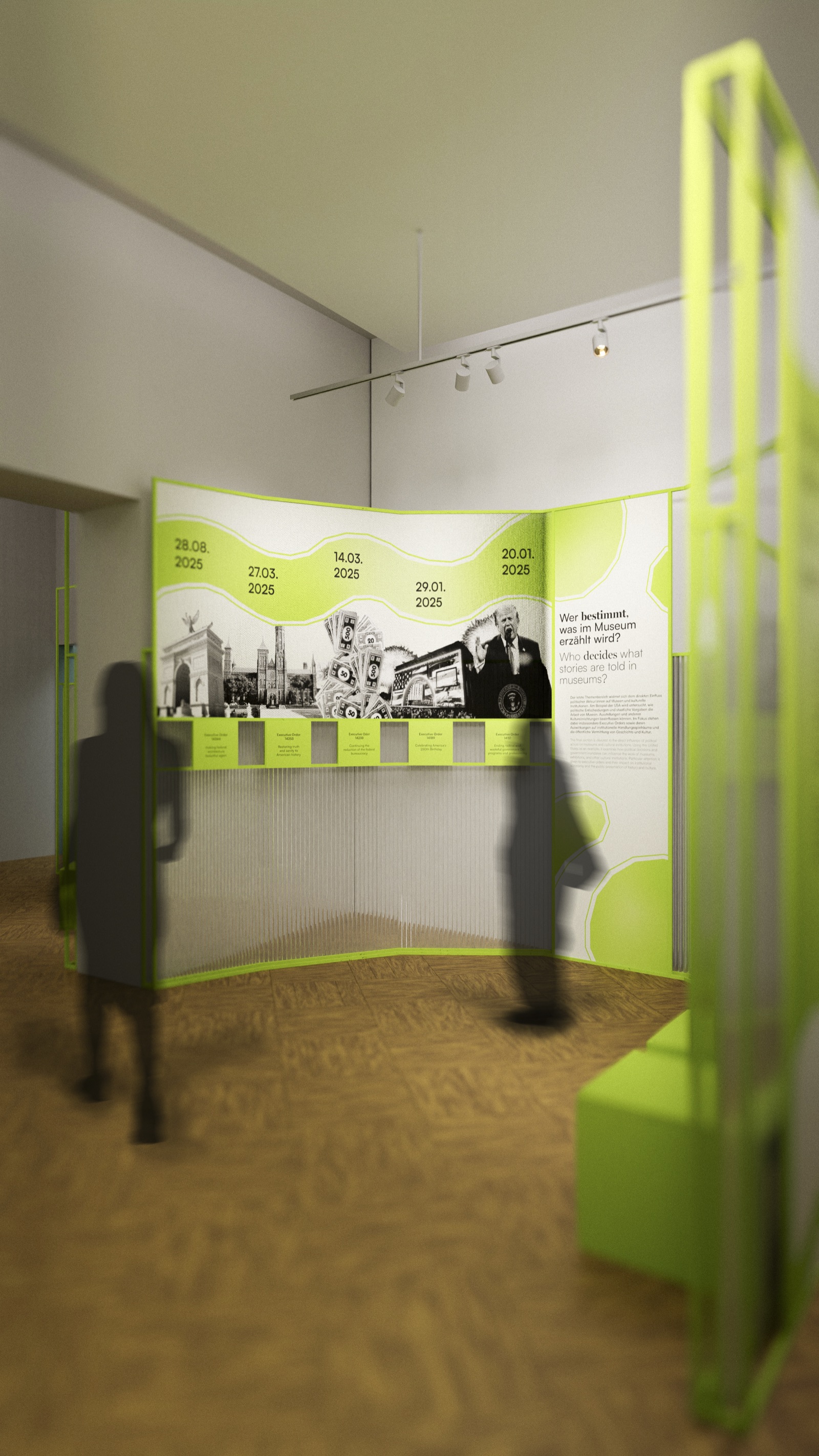
The second room explains what visitors have just experienced. Four topics take up the key questions of the thesis: Where does manipulation through design begin? What is shown and what is left out? How does design shape our perception? Who decides what is told? Each question has its own interactive station. One is a sliding “censorship filter” that hides every passage of a museum text that doesn’t fit the national myth. Another lets visitors change the light, sound and label of a pair of old leather boots, which become a soldier’s boots or the boots of a refugee.
Room 3
Nation
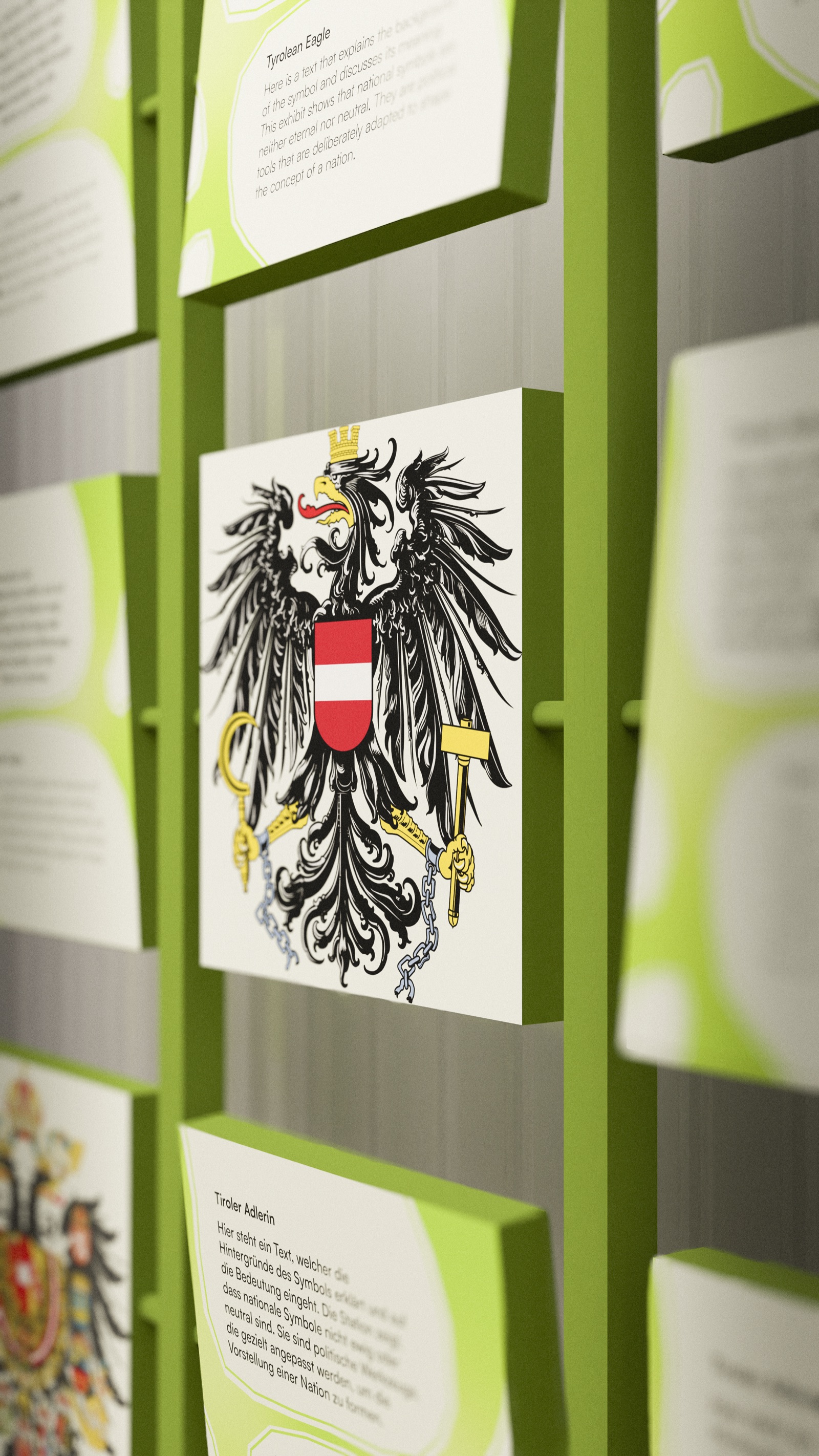
The last room deals with the idea of the nation and how it is used politically: flags and anthems, folk culture and sporting events. National identity is not shown as bad in itself, but as ambivalent. It can create belonging and orientation, but it can also exclude others. Questions such as “How is the idea of a nation formed?”, “What meaning do we give national symbols?” and “How is a nation made?” close the exhibition and lead back to the topics of the museum analysis.
Conclusion
Museums are under pressure from a global shift to the right and a rise in autocracy, as the US shows. In Europe, too, it is a growing problem. That is why it matters now to keep designing critical exhibitions that support democracy. My exhibition concept does this by translating nationalist-authoritarian mechanisms into a spatial format. It doesn’t only explain how manipulation works: it lets visitors experience it, so they can question it.
My analysis can only show these mechanisms through examples, not prove them across the board. The study is limited to two case studies in the Western world. A larger and more diverse study could show how these mechanisms appear in other contexts.